FT Nexavvy LogoCONTACT US
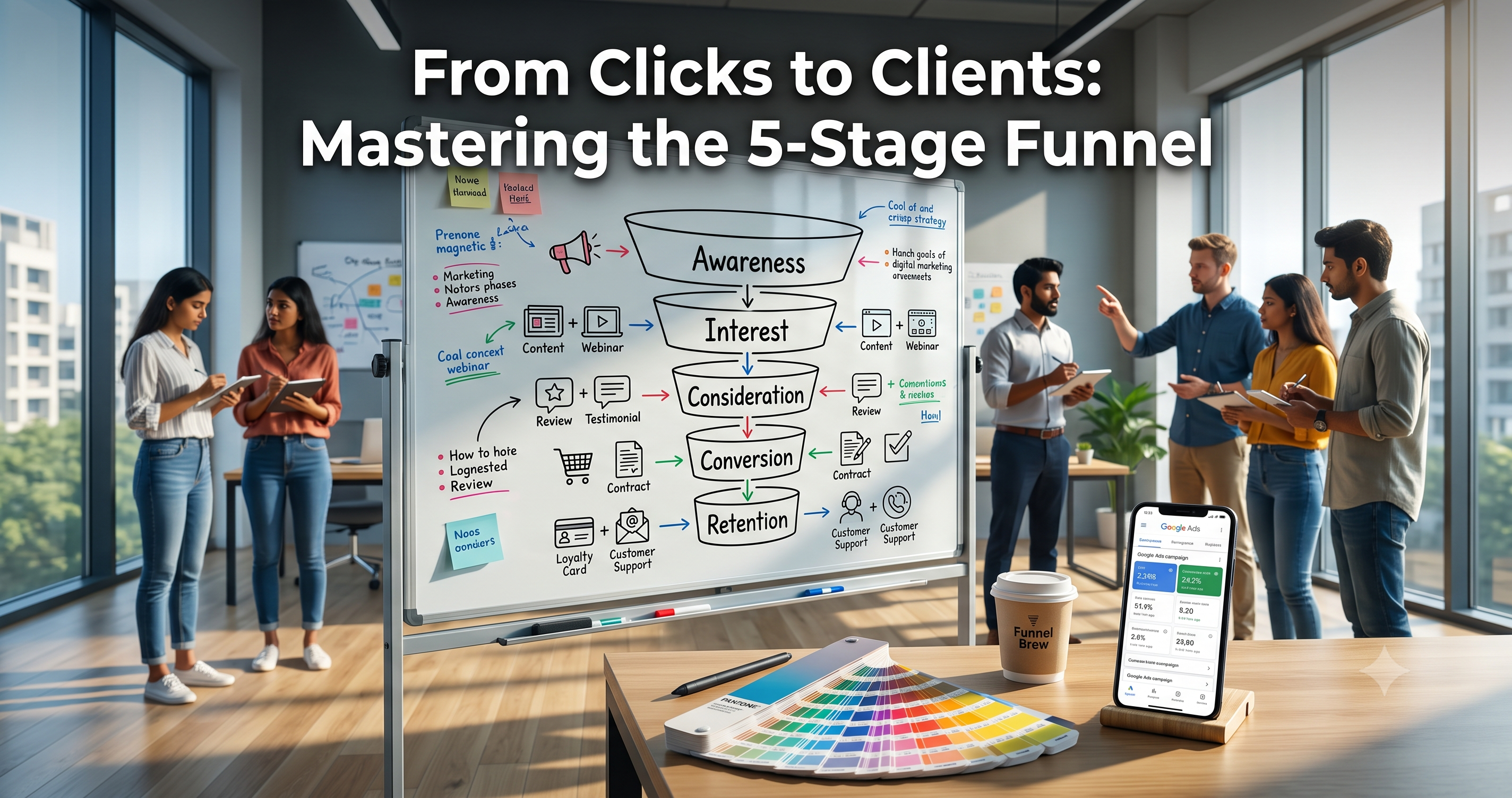
5-stage digital marketing funnel illustrating awareness, interest, consideration, conversion, and customer retention to turn website visitors into loyal customers by FT Nexavvy Private Limited.

Digital Marketing Funnel: 5 Stages to Turn Visitors into Customers

Comprehensive guide and insights about Content Marketing: Digital Marketing Funnel: 5 Stages to Turn Visitors into Customers

Recent12 MIN Read    BYFT Nexavvy
Most customers do not discover a business and purchase immediately.
They search for information, explore options, compare businesses, read reviews, visit websites, and sometimes return several times before making a decision.
A digital marketing funnel helps businesses understand this journey.
It maps how people move from discovering a brand to becoming customers and, ideally, loyal advocates.
Understanding this journey helps businesses choose the right marketing channels, content, messages, and offers at each stage.
Instead of expecting every visitor to convert immediately, businesses can build a connected experience that guides potential customers towards the next logical action.

Strategy #1: What Is a Digital Marketing Funnel?

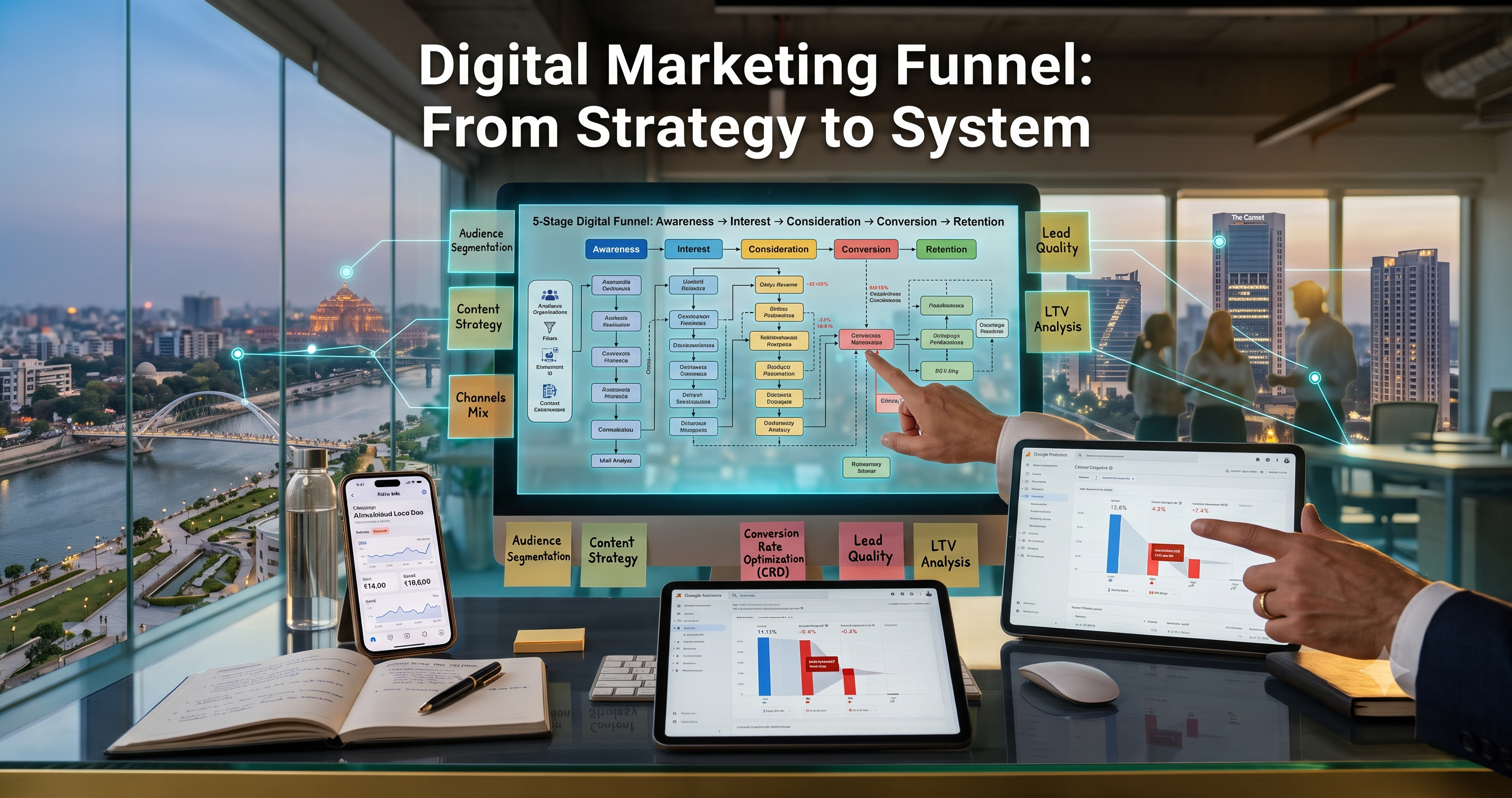
Digital marketing funnel system illustrating audience segmentation, content strategy, lead generation, conversion optimization, lead qualification, and customer retention for sustainable business growth by FT Nexavvy Private Limited.
A digital marketing funnel is a framework that maps how potential customers move from discovering a business to becoming customers and building an ongoing relationship with the brand.
The five main stages are Awareness, Interest, Consideration, Conversion, and Retention.
Businesses can use SEO, content marketing, social media, Google Ads, and Meta Ads to attract audiences. Helpful content, email, case studies, reviews, and remarketing can support evaluation.
Landing pages and conversion optimization help turn prospects into customers, while email and marketing automation support retention.
A successful funnel connects these stages and measures how customers progress between them.

"Most customers do not discover a business and purchase immediately. A digital marketing funnel helps businesses understand this journey and build a connected experience that guides visitors towards conversion."

FT Nexavvy

Strategy #2: Why Does the Digital Marketing Funnel Matter?

Customer journeys are rarely straightforward.
A person may see an Instagram advertisement today, search your company on Google tomorrow, visit your website next week, and contact you several days later.
If you measure only the final interaction, you may miss the channels that influenced the decision.
The digital marketing funnel helps businesses understand the complete journey.
It can help answer:
  • How do customers discover us?
  • What makes them interested?
  • What information do they need?
  • Why do they choose us?
  • Why do some visitors leave?
  • What brings customers back?
This creates a more customer-focused marketing strategy.
Instead of asking, "Which platform generates the most clicks?" businesses can ask, "Which combination of touchpoints helps customers make decisions?"
That is a much more useful question.

Strategy #3: Digital Marketing Funnel vs Customer Journey

The funnel and customer journey are related but not identical.
FactorMarketing FunnelCustomer Journey
PerspectiveBusiness frameworkCustomer experience
StructureOrganised stagesOften non-linear
FocusMoving prospects forwardUnderstanding interactions
MeasurementStage performanceCustomer touchpoints
GoalImprove conversionImprove overall experience
In practice, customers may move backwards, leave, return, compare competitors, or interact with multiple channels.
Businesses should use the funnel as a planning framework rather than assuming every customer follows an identical path.

Strategy #4: The 5 Digital Marketing Funnel Stages

Understanding the digital marketing funnel stages helps businesses create more relevant marketing activities.
Let us examine each stage.

Strategy #5: Stage 1: Awareness – Help Customers Discover Your Business

Customer engaging with Instagram content on a smartphone, demonstrating the awareness and interest stages of the digital marketing funnel through social media marketing by FT Nexavvy Private Limited.
The awareness stage sits at the top of the funnel.
At this point, potential customers become aware of a problem, need, solution, or brand.
They may not be ready to purchase. Your first objective is visibility.

Useful Awareness Channels

Businesses can use:
  • SEO
  • Educational content
  • Social media
  • Meta Ads
  • YouTube
  • Video marketing
  • Display advertising
  • Digital PR
  • Local SEO
For example, someone searching "how to improve website traffic" may not be searching for an SEO agency yet. An educational article answering that question can introduce your business.

Best Content for Awareness

Create content that answers broad questions:
  • Beginner guides
  • Educational articles
  • Explainer videos
  • Industry insights
  • Social media posts
  • Research
  • Checklists
Avoid pushing aggressive sales messages too early. Help first. Selling can come later.

Awareness Metrics

Track:
  • Organic impressions
  • Search visibility
  • Website reach
  • Social reach
  • Video views
  • New website users
  • Branded searches
The objective is to reach relevant people, not simply the largest possible audience.

Strategy #6: Stage 2: Interest – Build Relevance and Engagement

Page awareness gets attention. Interest keeps it.
At this stage, people understand their problem and start exploring possible solutions.
They may read more articles, follow your social accounts, watch videos, or subscribe to email updates. Your job is to deepen engagement.

Useful Interest-Stage Content

Consider:
  • Detailed guides
  • Email newsletters
  • Webinars
  • Comparison articles
  • How-to videos
  • Downloadable resources
  • Industry-specific content
The content should move from broad education towards practical solutions.
Example:
A business owner may first search: "What is SEO?"
Later, they may search: "How does SEO help small businesses?"
Then: "How much does SEO cost?"
The search intent is changing. Your content should support this progression.

Interest Metrics

Track:
  • Returning visitors
  • Email sign-ups
  • Content engagement
  • Video completion
  • Pages viewed
  • Resource downloads
These signals can indicate deeper interest, although no single metric proves purchase intent.

Strategy #7: Stage 3: Consideration – Help Customers Evaluate Their Options

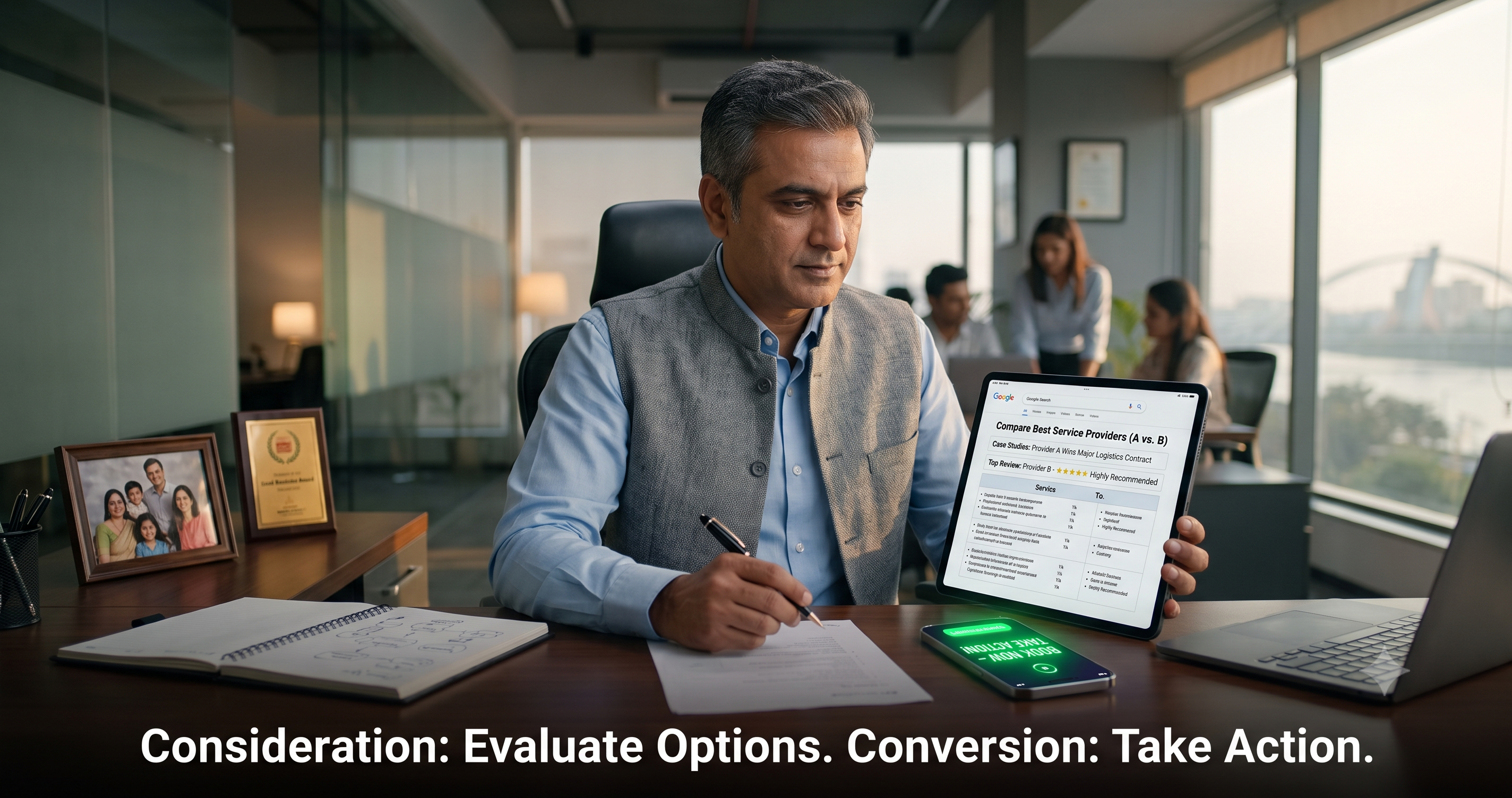
Business decision-maker comparing service providers on a digital device during the consideration and conversion stages of the digital marketing funnel to make an informed purchasing decision by FT Nexavvy Private Limited.
The consideration stage is where potential customers become more serious.
They understand their problem. They know possible solutions. Now they are evaluating options.
This stage often includes commercial research where trust becomes increasingly important.
Customers may examine:
  • Service pages
  • Product features
  • Pricing
  • Reviews
  • Case studies
  • Testimonials
  • Competitor comparisons
  • Company experience

Useful Consideration Channels

Businesses can use:
  • SEO
  • Google Ads
  • Remarketing
  • Meta Ads
  • Email nurturing
  • Case studies
  • Comparison content
  • Service pages
For high-consideration purchases, this stage may last weeks or months. A person buying a ₹1,000 product may decide quickly. A company selecting a long-term marketing partner may require multiple discussions. Your funnel should reflect the real sales cycle.

Consideration Metrics

Monitor:
  • Service page visits
  • Pricing page visits
  • Returning users
  • Case study views
  • Remarketing engagement
  • High-intent search traffic
The goal is to reduce uncertainty and help customers make informed decisions.

Strategy #8: Stage 4: Conversion – Turn Prospects Into Customers

The conversion stage is where the customer takes a meaningful business action.
Depending on the company, this could mean:
  • Making a purchase
  • Submitting a form
  • Booking an appointment
  • Calling the business
  • Sending a WhatsApp enquiry
  • Requesting a quotation
  • Scheduling a demo
Traffic alone does not create business growth. Conversion does. This is why conversion rate optimization matters.

Improve Conversion With

Focus on:
  • Clear calls to action (CTAs)
  • Relevant landing pages
  • Fast page loading
  • Mobile usability
  • Simple forms
  • Trust signals
  • Clear pricing where appropriate
  • Customer reviews
  • Strong offers

Message Match Matters

The advertisement, search query, and landing page should align.
For example:
  • Search: SEO services in Ahmedabad
  • Ad: SEO Services for Ahmedabad Businesses
  • Landing Page: Dedicated Ahmedabad SEO service page
This creates stronger message consistency. Sending every campaign to the homepage can create unnecessary friction.

Conversion Metrics

Track:
  • Leads
  • Sales
  • Bookings
  • Calls
  • Conversion rate
  • Cost per lead
  • Customer acquisition cost
  • Revenue
  • Return on ad spend (ROAS)
The most important metrics depend on your business model.

Strategy #9: Stage 5: Retention – Turn Customers Into Long-Term Relationships

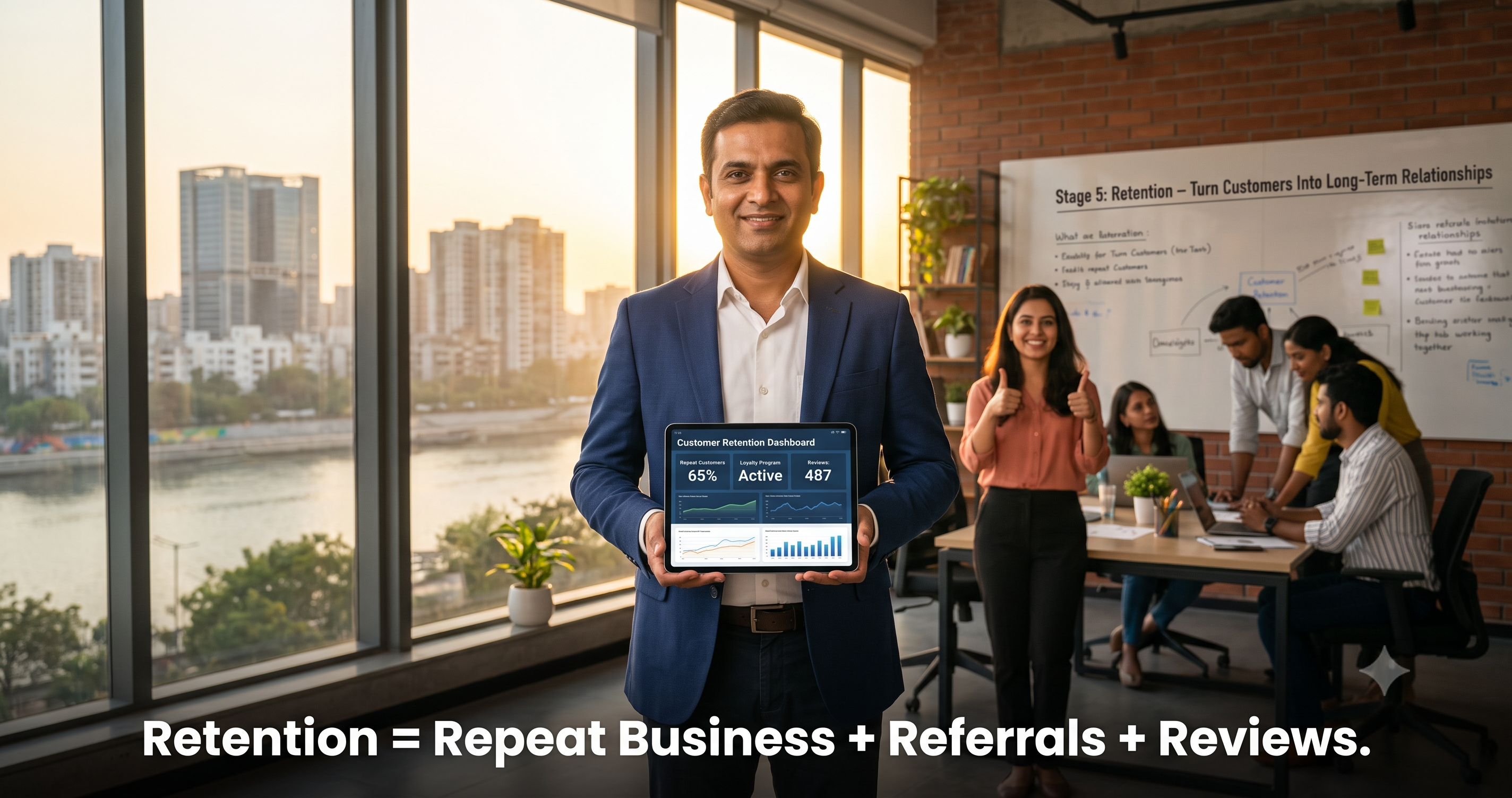
Business leader presenting a customer retention dashboard showing repeat customers, loyalty programs, customer reviews, and referral growth during the retention stage of the digital marketing funnel by FT Nexavvy Private Limited.
The funnel should not end after conversion.
Existing customers can provide repeat business, referrals, reviews, and long-term value. Retention strategies focus on maintaining useful relationships.

Retention Channels

Businesses can use:
  • Email marketing
  • Marketing automation
  • Customer support
  • Loyalty programmes
  • Personalised offers
  • Educational content
  • Community building
  • Remarketing

Simple Retention Workflow

A basic workflow may look like:
Purchase → Onboarding → Support → Follow-Up → Repeat Purchase → Referral
The exact process depends on the business (e.g., SaaS product adoption, ecommerce repeat purchases, or service company renewals and referrals).

Retention Metrics

Track:
  • Repeat purchase rate
  • Customer retention rate
  • Churn
  • Customer lifetime value (CLV)
  • Referral rate
  • Review generation
Customer acquisition matters, but customer retention often determines long-term profitability.

Strategy #10: Digital Marketing Funnel Strategy: Matching Channels to Stages

Different marketing channels can contribute at multiple funnel stages.
Funnel StageCustomer GoalUseful ChannelsContent
AwarenessDiscover solutionsSEO, Social, Meta AdsBlogs, videos
InterestLearn moreContent, EmailGuides, newsletters
ConsiderationCompare optionsGoogle Ads, SEO, RemarketingCase studies, service pages
ConversionTake actionLanding pages, CROOffers, forms
RetentionStay connectedEmail, AutomationUpdates, support

Strategy #11: Benefits of a Digital Marketing Funnel

Better Customer Understanding

The funnel encourages businesses to think about what customers need at each stage.

More Relevant Marketing

Different messages can be created for different levels of intent.

Improved Budget Allocation

Businesses can understand where investment is required across the journey.

Higher Conversion Potential

Identifying funnel drop-offs helps businesses focus optimization efforts.

Better Measurement

Each stage can have relevant KPIs.

Stronger Customer Retention

The funnel encourages businesses to think beyond the initial transaction.

Strategy #12: How to Build a Digital Marketing Funnel

  • Step 1: Define the Conversion Goal – Decide what action represents success. It could be a sale, lead, booking, call, or demo request.
  • Step 2: Understand Your Audience – Research customer needs, questions, objections, and buying triggers.
  • Step 3: Map the Customer Journey – Identify how customers move from discovery to decision. Include online and offline touchpoints where relevant.
  • Step 4: Create Content for Each Stage – Build educational, consideration, and conversion-focused content. Avoid using one message everywhere.
  • Step 5: Select Marketing Channels – Choose channels based on customer behaviour. Do not select platforms simply because competitors use them.
  • Step 6: Build Conversion Paths – Connect content, advertisements, landing pages, forms, and follow-ups. Every important page should have a logical next step.
  • Step 7: Set Up Measurement – Use tools such as Google Analytics, Google Search Console, advertising platform reporting, and CRM data where appropriate.
  • Step 8: Find Funnel Leaks – Identify where potential customers stop progressing. Then investigate why.
  • Step 9: Optimise – Improve the biggest bottleneck first.
  • Step 10: Retain Customers – Build post-purchase communication and retention into the funnel.

Strategy #13: Digital Marketing Funnel Example

Consider a real estate company in Ahmedabad:
  • Awareness: A potential buyer searches for information about buying property in Ahmedabad. They discover an educational blog through Google.
  • Interest: They explore neighbourhood guides and property-buying content.
  • Consideration: They visit project pages, compare properties, and watch walkthrough videos.
  • Conversion: They submit an enquiry or schedule a site visit.
  • Retention: The company follows up with relevant property updates and personalised recommendations.
The customer may interact with SEO, Google Ads, Meta Ads, content, WhatsApp, and email throughout this journey.
This shows why channel attribution can be complex. The final conversion may result from several interactions rather than one campaign.

Strategy #14: Common Digital Marketing Funnel Mistakes

Businesses often lose potential customers because of gaps between funnel stages.
Common mistakes include:
  • Focusing only on awareness.
  • Expecting every visitor to convert immediately.
  • Using the same message at every stage.
  • Creating content without a next step.
  • Sending paid traffic to generic pages.
  • Ignoring remarketing opportunities.
  • Using overly complicated forms.
  • Tracking clicks instead of conversions.
  • Ignoring lead quality.
  • Stopping communication after conversion.
  • Scaling traffic before fixing funnel leaks.
A strong funnel is not about pushing customers faster. It is about reducing unnecessary friction.

Strategy #15: Expert Tips for a Better Marketing Funnel

Match Content With Intent

Educational searches need educational content. Commercial searches need stronger decision-support information.

Build Clear Internal Links

Informational content should naturally guide relevant readers towards deeper resources or service pages.

Connect Marketing and Sales Data

Marketing teams may generate leads. Sales teams know which leads become customers. Combine both perspectives.

Track Micro-Conversions

Not everyone converts immediately. Newsletter subscriptions, resource downloads, and repeat visits can provide useful behavioural signals.

Use Remarketing Carefully

Remarketing can reconnect with interested audiences. Avoid overwhelming users with repetitive advertisements.

Use AI to Improve Analysis

AI tools can help analyse customer questions, segment content ideas, identify patterns, and support workflow automation. Human oversight remains important for strategy, accuracy, and customer experience.

Strategy #16: Digital Marketing Funnel for Ahmedabad Businesses

Ahmedabad has a diverse commercial ecosystem.
Businesses operate across manufacturing, pharmaceuticals, healthcare, education, ecommerce, real estate, technology, retail, and professional services.
Their funnels can look very different:
  • A clinic: Google Search → Google Business Profile → Website → Appointment
  • A real estate business: Meta Ad → Property Page → Remarketing → Site Visit
  • A B2B manufacturer: Google Search → Technical Article → Product Page → Enquiry → Sales Follow-Up
  • An ecommerce business: Instagram → Product Page → Abandoned Cart → Email → Purchase
Businesses should map their actual customer behaviour rather than copying another industry's funnel.
For Ahmedabad companies, local SEO can also support discovery when customers search for nearby products, services, or providers.
The most effective funnel reflects your market, sales cycle, customer behaviour, and business goals.

Strategy #17: Frequently Asked Questions

A digital marketing funnel is a framework that maps how people move from discovering a business to becoming and remaining customers.

The five stages are awareness, interest, consideration, conversion, and retention.

It helps businesses understand customer behaviour and create more relevant marketing for different stages of the buying journey.

The top of the funnel is the awareness stage, where potential customers first discover a problem, solution, or brand.

The middle typically includes interest and consideration, where customers research solutions and evaluate available options.

The bottom focuses on conversion, where high-intent prospects take actions such as purchasing or submitting an enquiry.

No. A funnel is a simplified business framework, while the customer journey represents the actual and often non-linear customer experience.

SEO can attract customers through informational, commercial, local, and transactional searches across multiple funnel stages.

Google Ads can capture active search demand, particularly when users show commercial or transactional intent.

Meta Ads can support awareness, demand generation, lead generation, customer acquisition, and remarketing.

Funnel conversion rate measures the percentage of users who move from one defined stage or action to another.

Businesses can improve targeting, content relevance, landing pages, website speed, calls to action, trust signals, and follow-up processes.

A funnel leak occurs when a significant number of potential customers stop progressing at a particular stage.

Analytics helps businesses understand user behaviour, traffic sources, conversion paths, and potential drop-off points.

Content helps educate customers, answer questions, build trust, and support decision-making throughout the funnel.

Strategy #18: Conclusion

A digital marketing funnel helps businesses understand how customers move from discovery to long-term relationships.
The five stages—awareness, interest, consideration, conversion, and retention—provide a practical framework for planning marketing activities.
However, real customer journeys are rarely perfectly linear. Customers may interact with SEO, Google Ads, Meta Ads, social media, content, email, reviews, and websites before making a decision.
The goal is not to force customers through a rigid funnel. The goal is to provide the right information and experience whenever they need it.
Map the journey. Identify the gaps. Remove unnecessary friction. Measure meaningful outcomes. Then improve the weakest stage.
That is how a marketing funnel becomes a practical business growth system.

Ready to Build Your Digital Acquisition Funnel?

Building an effective funnel becomes difficult when SEO, paid advertising, content, website development, analytics, and conversion optimization operate separately.
Businesses looking to create an integrated acquisition and conversion system can explore our digital marketing agency in Ahmedabad services to understand how SEO, Google Ads, Meta Ads, performance marketing, content, analytics, and conversion optimisation can work together.

Read Related Articles:

Branding

Traditional Marketing vs Digital Marketing: Complete Comparison

Analytics

15 Common Digital Marketing Mistakes You Need to Avoid

Author

FT Nexavvy

FT Nexavvy

Digital Marketing Expert at FT Nexavvy.

InstagramFacebookTwitterLinkedIn

ON THIS PAGE

Related Articles

Have a Project?
Let’s talk!

green tick

NDA? Absolutely just ask.

green tick

We’ll respond in 24 hours fast & focused.

green tick

Work with senior UX experts, not juniors.

Schedule a call:

Mr Panchal

Founder & CEO

How can we help you?

Send Message

Prefer email?

hello@ftnexavvy.com

UI/UX DESIGN
WEBSITE DESIGN
BRANDING
GOOGLE ADS
SEO
SOCIAL MEDIA MARKETING
UI/UX DESIGN
WEBSITE DESIGN
BRANDING
GOOGLE ADS
SEO
SOCIAL MEDIA MARKETING
UI/UX DESIGN
WEBSITE DESIGN
BRANDING
GOOGLE ADS
SEO
SOCIAL MEDIA MARKETING
FT Nexavvy Logo

DIGITAL MARKETING AGENCY IN AHMEDABAD

ISO Certification Badge

Working Hours

Monday – Saturday 9:00 am – 6:00 pm ( Sunday > Closed )

Use Cases

Travel

Health & Fitness

Educations

News App

Food Order & Delivery App

Work inquiries

Interested in working with us?
hello@ftnexavvy.com

Call : +91 90303 48383

Ahmedabad Office:
A-531, Money Plant High Street,
Gota, Ahmedabad - 382470

Career

Looking for a job opportunity?
See open positions

Sign up for the newsletter

flag-1flag-2flag-3flag-4flag-5flag-6flag-7flag-8flag-9flag-10

Disclaimer

FT NEXAVVY PRIVATE LIMITED (CIN:U62011GJ2025PTC168186) is a registered company under the Companies Act, 2013.
We operate with GST (GSTIN:24AAGCF6405M1ZJ), PAN ( AAGCF6405M), TAN (BRDF01128B), DPIIT Registration (DIPP225956), and MSME / UDYAM Registration (Udyam No:UDYAM-GJ-01-0555205).

Our brand name FT NEXAVVY is currently under Trademark Application (Application No:7297017) with the relevant authorities in India.

We are committed to providing transparent, ethical, and result-driven digital solutions. While our strategies are based on proven industry standards, actual results may vary depending on market conditions, competition, and platform algorithm updates.

As a responsible agency, we do not guarantee fixed sales, instant leads, or overnight rankings. Digital success requires consistent effort, collaboration, and long-term commitment. All services are executed only as per the mutually agreed scope of work in our service agreements.Any additional tasks or requirements may involve revised terms.

For your safety, please note that FT Nexxavy Private Limited has not authorized any third party or individual to make commitments, promise guaranteed results, or operate accounts on your behalf. Always communicate with us only through our official channels for authentic updates and support.

If you find any unauthorized use of our brand name, please report it immediately at legal@ftnexavvy.com

© 2025-2026 Nexavvy. All rights reserved.

Nexavvy