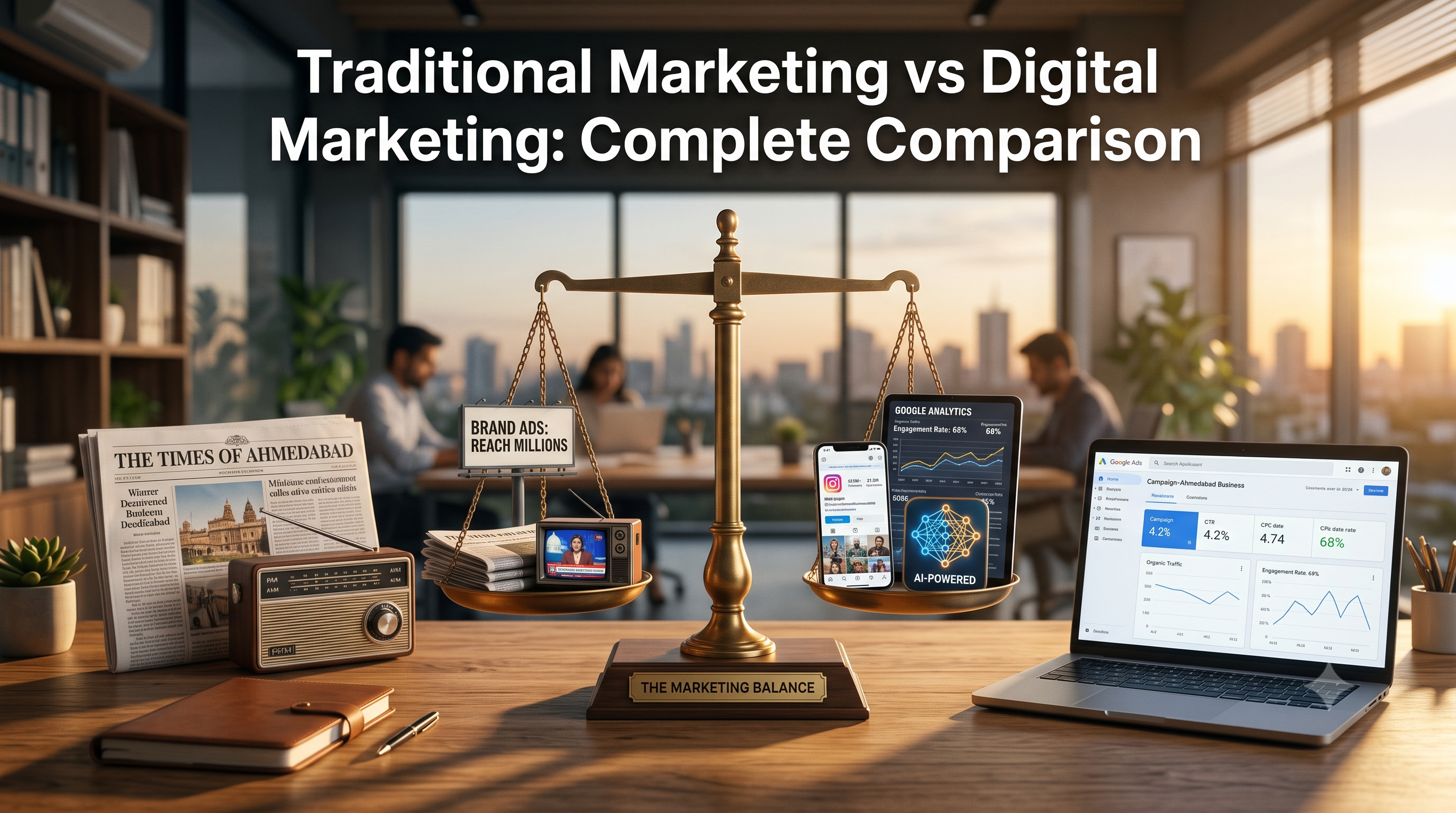
Strategy #1: Traditional Marketing vs Digital Marketing – Which Is Better?
"The traditional marketing vs digital marketing debate does not have one universal winner. The best approach is not choosing one and rejecting the other; it is understanding how your customers make decisions."
– FT Nexavvy
Strategy #2: What Is Traditional Marketing?
- Television and radio advertisements
- Newspaper and magazine advertising
- Billboards and hoardings
- Flyers, brochures, and direct mail
- Trade shows, events, and sponsorships
Strategy #3: What Is Digital Marketing?
- Search Engine Optimisation (SEO)
- Google Ads
- Meta Ads
- Social media marketing
- Content marketing
- Email marketing
- Local SEO
- Video marketing
- Performance marketing
- Marketing automation
Strategy #4: Difference Between Traditional Marketing and Digital Marketing
| Factor | Traditional Marketing | Digital Marketing |
|---|---|---|
| Channels | TV, radio, print, billboards | Search, social, email, websites |
| Audience Reach | Often broad | Broad or highly targeted |
| Targeting | Limited to medium | More granular |
| Measurement | Often indirect | More detailed |
| Interaction | Mostly one-way | Often two-way |
| Budget Flexibility | Often less flexible | Usually more flexible |
| Optimisation | Slower | Faster |
| Personalisation | Limited | More advanced |
| Geographic Reach | Often local or regional | Local to global |
| Attribution | More difficult | More measurable, but not perfect |
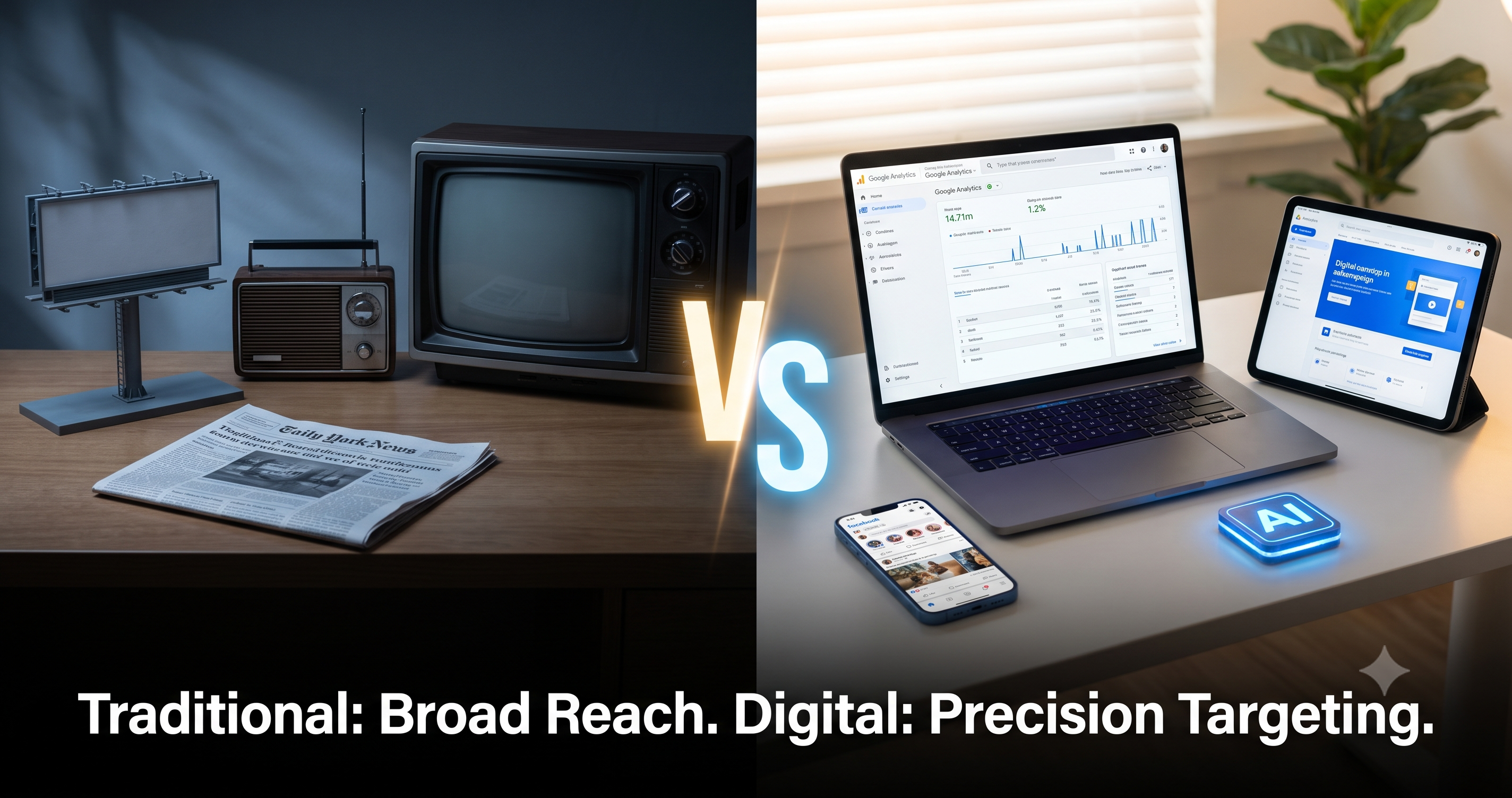
Strategy #5: 1. Audience Targeting, Cost Flexibility, and Reach

Audience Targeting
Cost and Budget Flexibility
Reach
Strategy #6: 2. Performance, Speed of Optimisation, and Interaction

Performance Measurement
Speed of Optimisation
Customer Interaction
Strategy #7: 3. Personalisation, Scalability, and Brand Trust
Personalisation
Trust and Brand Visibility
Conversion Tracking
Scalability
Strategy #8: Advantages and Disadvantages of Traditional Marketing
Advantages of Traditional Marketing
- Strong Local Visibility: Billboards and local publications can create strong geographic exposure.
- Mass Audience Reach: Television and radio can reach large audiences.
- Physical Presence: Brochures and printed materials provide tangible brand experiences.
- Familiarity: Some audiences trust established offline media channels.
- Brand Recall: Repeated outdoor or broadcast exposure can support awareness.
Disadvantages of Traditional Marketing
- Higher entry costs for some channels
- Limited targeting
- Difficult attribution
- Slower campaign changes
- Limited personalisation
- Mostly one-way communication
Strategy #9: Advantages and Disadvantages of Digital Marketing
Advantages of Digital Marketing
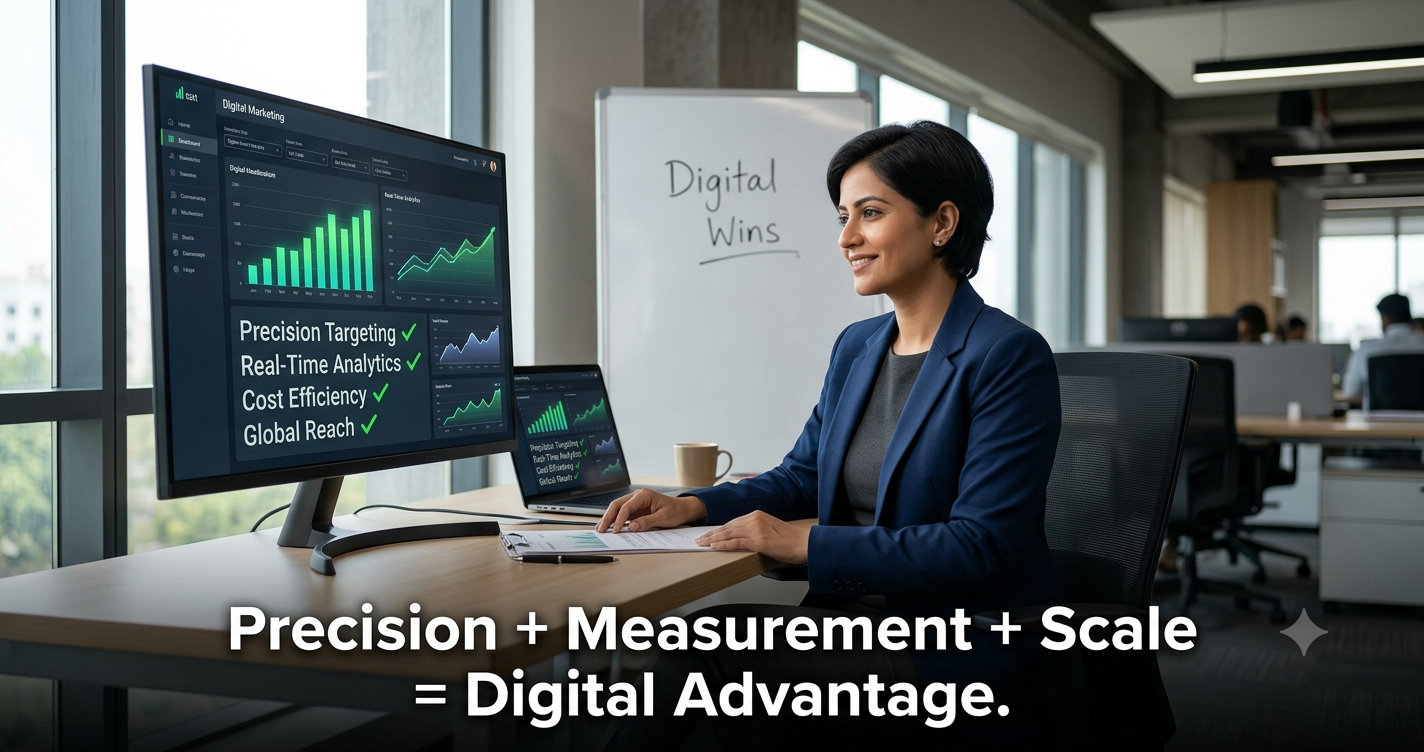
- Precise Audience Reach: Target customers based on intent, geography, and platform signals.
- Better Measurement: Campaign performance can be tracked more closely.
- Flexible Budgets: Adjust spending more easily based on performance.
- Faster Optimisation: Test and improve campaigns using real-time data.
- Customer Interaction: Direct communication through comments, messages, and reviews.
- Personalisation: Create more relevant customer experiences.
- Global Reach: Expand reach beyond physical boundaries.
- Multiple Funnel Touchpoints: Channels like SEO, email, and remarketing support different stages of the journey.
Disadvantages of Digital Marketing
- High Competition: Popular digital channels can become highly competitive and expensive.
- Constant Change: Search algorithms, advertising platforms, and privacy rules evolve regularly.
- Skill Requirements: Effective campaigns require strategy, technical knowledge, creative skills, and analysis.
- Data Complexity: More data does not automatically produce better decisions.
- Platform Dependency: Relying entirely on one platform increases operational risk.
Strategy #10: Traditional Marketing vs Digital Marketing Examples
- Traditional Approach: Billboards → Newspaper Ads → Property Expo → Site Visit
- Digital Approach: Google Search → Landing Page → Meta Remarketing → WhatsApp Enquiry → Site Visit
- Integrated Approach: See Billboard → Search Brand on Google → Visit Website → Watch Video → Submit Enquiry
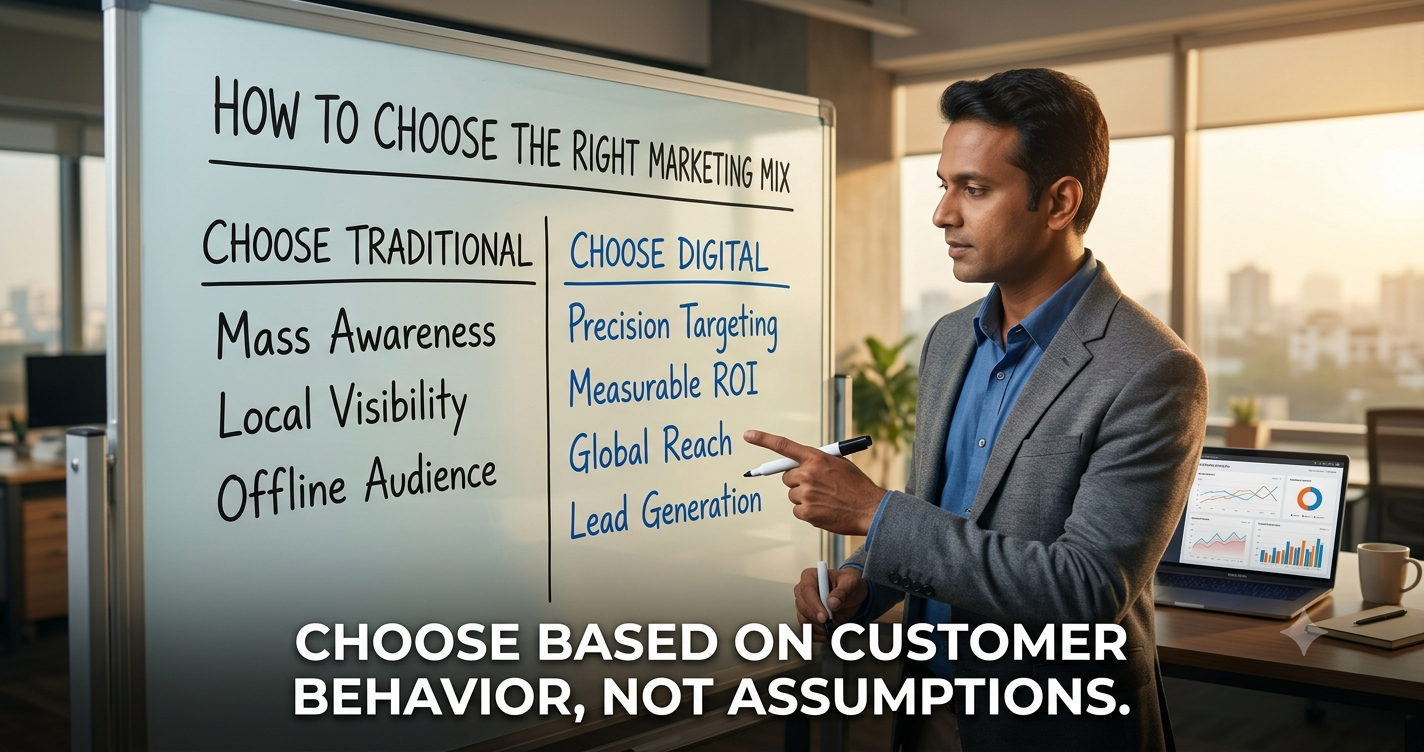
Strategy #11: When to Choose Traditional vs Digital Marketing

Choose Traditional Marketing When:
- Your audience consumes offline media heavily.
- Geographic visibility is important.
- You need broad local awareness.
- Physical presence supports brand credibility.
- Your business participates in events or exhibitions.
Choose Digital Marketing When:
- Customers actively search online.
- Precise targeting matters.
- You need measurable conversions.
- Budgets require flexibility.
- Your audience uses social platforms.
- You want to test campaigns quickly.
- You serve multiple geographic markets.
- Lead generation is important.
Strategy #12: How to Choose the Right Marketing Mix
- Step 1: Understand Your Customer – Identify where customers spend time and how they discover businesses.
- Step 2: Define Your Goal – Decide whether the priority is awareness, leads, sales, retention, or brand building.
- Step 3: Map the Customer Journey – Understand which online and offline touchpoints influence decisions.
- Step 4: Allocate Budget by Role – Do not divide budgets equally without reason. Fund channels based on their purpose.
- Step 5: Measure Business Impact – Track leads, sales, revenue, and customer acquisition where possible.
Strategy #13: Traditional vs Digital Marketing for Ahmedabad Businesses

- A real estate developer may combine outdoor advertising with Google Ads, Meta Ads, video marketing, and remarketing.
- A healthcare provider may prioritise local SEO, Google Business Profile visibility, search advertising, and offline reputation.
- A B2B manufacturer may use trade shows alongside SEO, technical content, Google Search, and email nurturing.
- A local retail business may combine outdoor signage with local SEO and social media.
Strategy #14: Common Marketing Strategy Mistakes
- Choosing channels because competitors use them.
- Investing without defining clear goals.
- Measuring reach but ignoring conversions.
- Treating offline and online marketing separately.
- Running digital ads without conversion tracking.
- Sending all traffic to the homepage.
- Ignoring website quality.
- Focusing only on customer acquisition.
- Depending entirely on one platform.
- Scaling campaigns before measuring lead quality.
Strategy #15: Expert Tips
Track Offline-to-Online Behaviour
Build Strong Digital Foundations
Connect Marketing and Sales
Measure Incremental Value
Use AI for Analysis, Not Blind Decisions
Strategy #16: Frequently Asked Questions
Traditional marketing primarily uses offline channels, while digital marketing uses online platforms and technologies to reach customers.
Digital marketing provides stronger targeting, measurement, and flexibility in many cases. However, traditional marketing can remain effective for mass awareness and offline audiences.
Examples include television, radio, newspapers, magazines, billboards, brochures, direct mail, exhibitions, and events.
Examples include SEO, Google Ads, Meta Ads, social media, content marketing, email, local SEO, and performance marketing.
Yes. Its effectiveness depends on the target audience, industry, geographic market, campaign quality, and business objectives.
Digital marketing often provides more flexible entry budgets, but competitive channels can still require significant investment.
Digital marketing generally offers more granular audience and intent-based targeting.
Digital marketing typically provides more detailed measurement, although attribution can still be complex.
Yes. Integrated campaigns can combine offline brand exposure with online research, engagement, and conversion.
The right approach depends on customer behaviour and budget. Many small businesses benefit from targeted digital channels and selective local offline marketing.
Local SEO and digital advertising can be effective, while outdoor advertising and local print may also support visibility.
One major advantage is the ability to target, measure, test, and optimize campaigns using performance data.
Traditional marketing can provide broad exposure and strong physical visibility within selected markets.
Usually not. SEO often requires sustained technical, content, and authority-building work over time.
It depends on the audience and objective. Google Ads can capture active search demand, while newspapers may reach broader local audiences.
Strategy #17: Conclusion
Ready to Build Your Integrated Marketing Strategy?
Read Related Articles: