Measure the Leads, Enquiries and Sales That Matter to Your Business
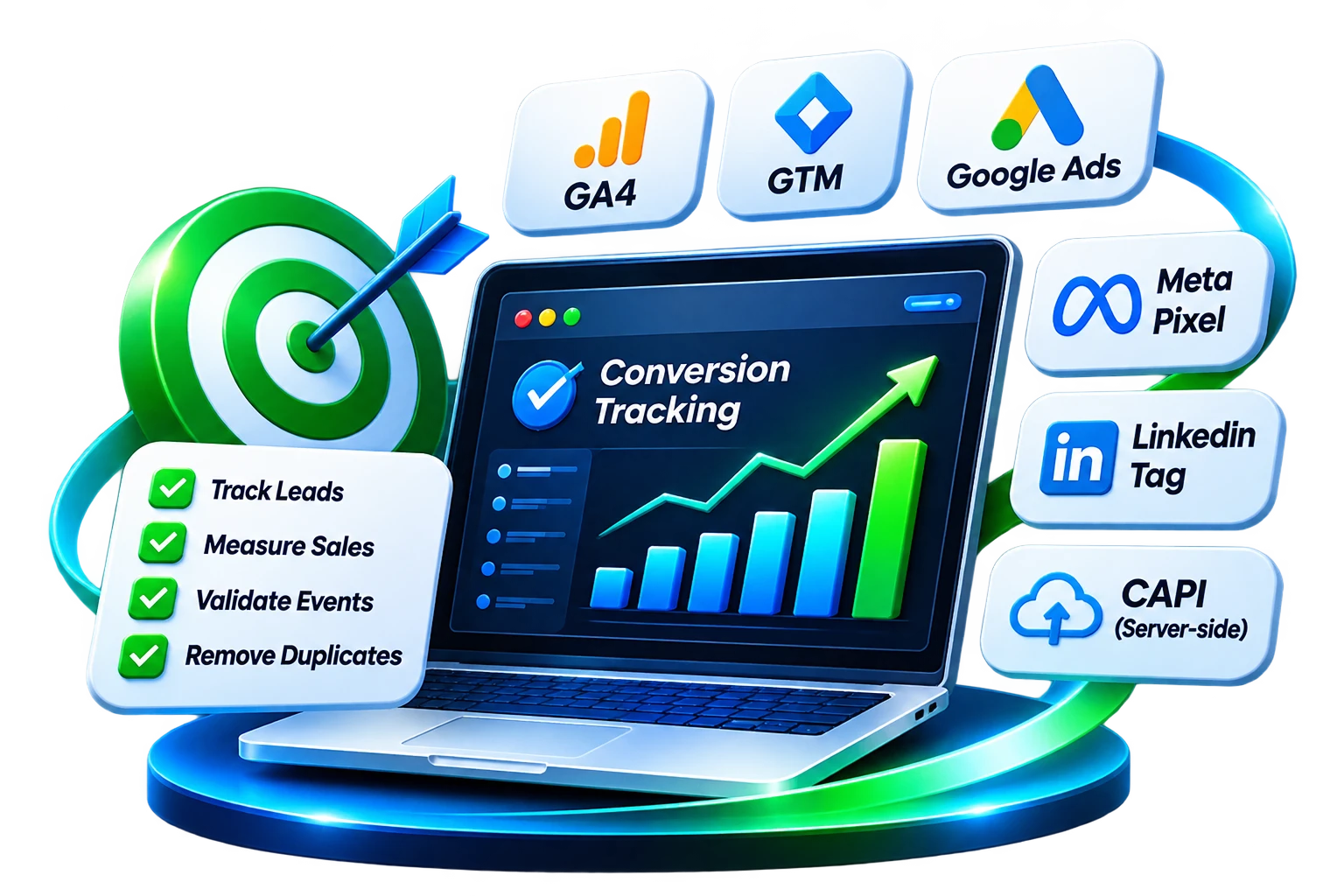
Measurement should distinguish a recorded interaction from a genuine enquiry, qualified lead or completed sale.
The event definitions and reporting scope are agreed before implementation.
Website traffic and advertising clicks show that people are reaching your business. They do not, by themselves, tell you how many visitors submitted a valid enquiry, called your team, requested a booking or completed a purchase. Conversion tracking connects important website actions with your analytics and advertising platforms so you can understand what is being measured and how marketing activity contributes to business outcomes.
FT Nexavvy provides conversion tracking services in Ahmedabad to help businesses plan, implement, test and document website and advertising conversion measurement. Depending on your website and agreed scope, this can include Google Analytics 4 (GA4), Google Tag Manager (GTM), Google Ads conversion tracking, Meta Pixel, Meta Conversions API, LinkedIn Insight Tag, lead-event tracking and ecommerce purchase measurement.
Whether you are setting up tracking for the first time or troubleshooting missing, duplicated or inconsistent conversion data, the process starts with understanding your business goals and defining the actions that should count as conversions.
Conversion tracking services help a business measure meaningful actions across its website and advertising platforms. The implementation includes deciding what to measure, configuring the relevant tools, checking whether events fire under the correct conditions and documenting what the resulting data represents.
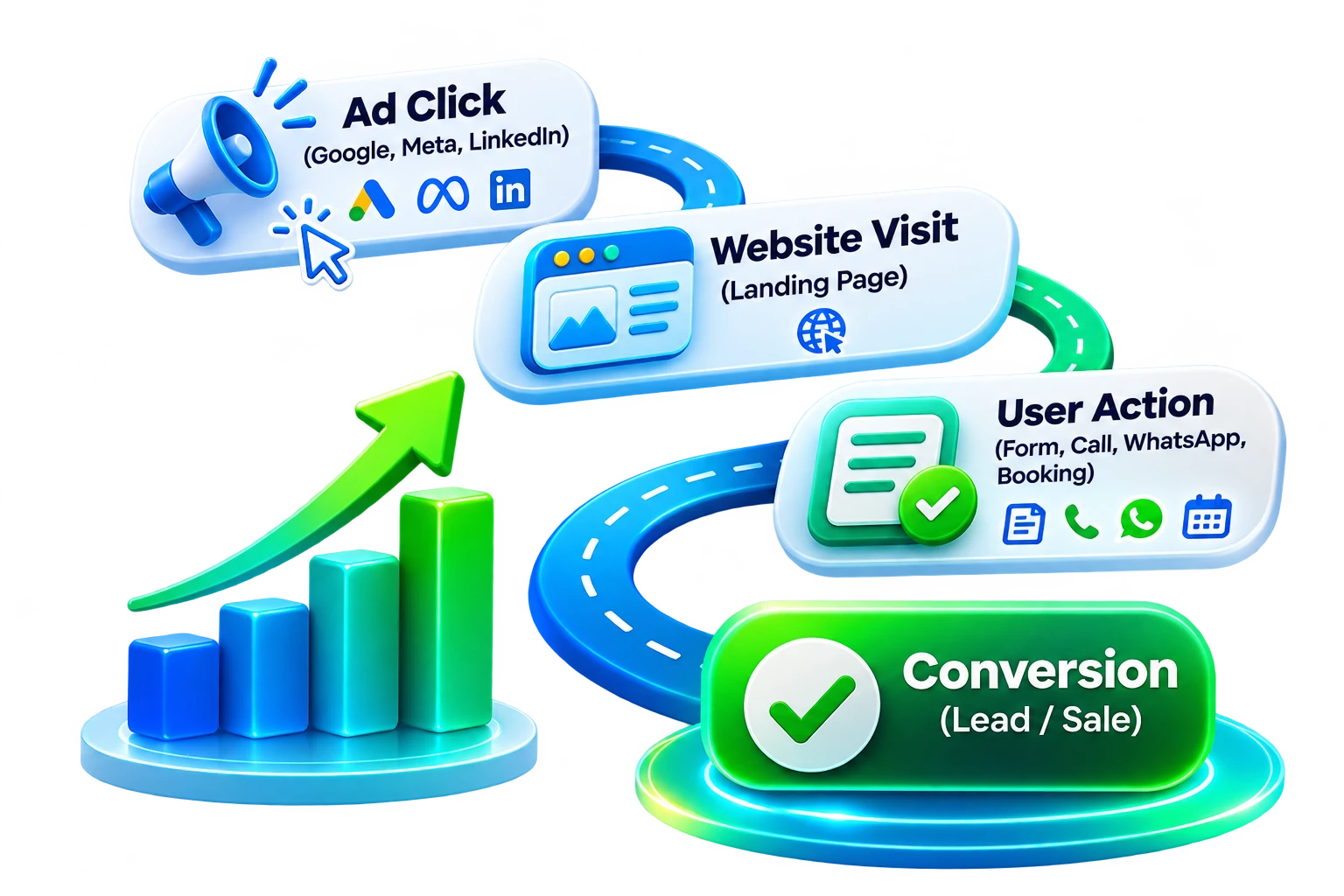
Review current tags, accounts, events and known measurement gaps before making changes.
Configure the relevant property, web data stream, events and key events.
Organise tags, triggers, variables and data-layer events where GTM is suitable for the implementation.
Configure agreed website, lead, purchase or eligible call conversion actions.
Install and validate browser events for relevant website actions.
Plan server-side event delivery where the website, platform access and data requirements support it.
Configure relevant website measurement for LinkedIn campaigns where applicable and appropriate.
Measure successful forms, phone-link clicks, WhatsApp clicks, bookings and registrations as separate event types.
Measure product interactions, checkout steps and completed purchases, including transaction information where available.
Check tag firing, event parameters, duplicate events and platform receipt.
Provide agreed tracking documentation, configuration notes and reporting support. A custom Looker Studio dashboard can be included when it is part of the approved scope.

A tracking review may be useful when you notice any of the following operational signals:
Your ads generate clicks, but you cannot tell which campaigns produce meaningful enquiries or purchases.
Website forms receive submissions, but the corresponding events are missing from analytics or advertising reports.
Google Ads and GA4 show different conversion totals and the reason is unclear.
WhatsApp or phone buttons are being counted as leads even though not every click becomes an inquiry.
Your ecommerce store records orders in its backend but purchase values or transaction events are missing from analytics.
A website redesign, form replacement, checkout update or plugin change has affected existing tags.
Multiple plugins, hard-coded scripts and GTM tags may be firing the same event more than once.
Your business wants to move from basic traffic reporting to a defined measurement plan for leads, sales and other important actions.
A conversion tracking setup creates or configures the agreed measurement system. It may include event planning, tag implementation, platform configuration, testing and handover.
A conversion tracking audit reviews the existing implementation. It checks whether tags are present, events are firing as intended, parameters are being passed, duplicate events exist and platform settings match the agreed measurement goals. FT Nexavvy’s conversion tracking audit services can result in recommendations, corrections or a separate implementation scope, depending on the engagement.
Conversion tracking gives marketing and business teams a clearer view of which measurable actions occur after people interact with a website or campaign. Without a defined tracking setup, reports can overemphasise clicks and visits while overlooking the quality and outcome of the enquiries those interactions generate.
When campaign parameters and conversion events are configured consistently, teams can examine available source, medium, campaign and conversion information together. This helps identify which traffic sources and campaigns are associated with form submissions, bookings, purchases or other defined actions.
Attribution is not the same as proof that a campaign caused a sale. Different platforms may apply different attribution models, lookback windows and reporting rules.
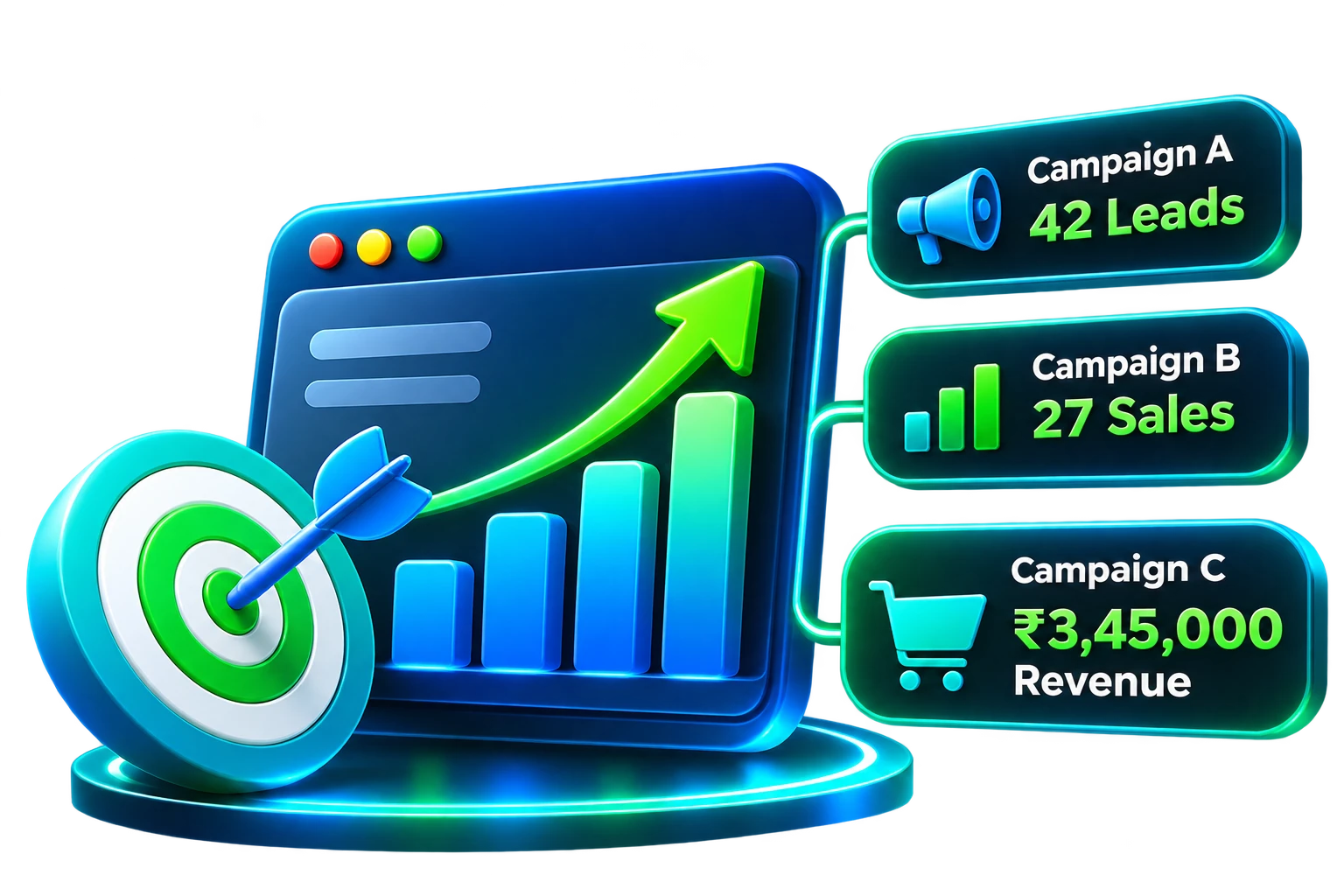
A useful measurement framework separates activity into meaningful stages:
| Measurement Stage | Example | What It Tells You |
|---|---|---|
| Exposure | Ad impression | An advertisement was served |
| Traffic | Ad click or website session | A user interacted with an ad or visited the site |
| Intent | CTA click, product view or form start | A visitor showed an interest signal |
| Conversion action | Successful form submission or purchase | A defined website action was completed |
| Lead or customer outcome | Qualified lead or confirmed sale | The business assessed or completed a later-stage outcome |
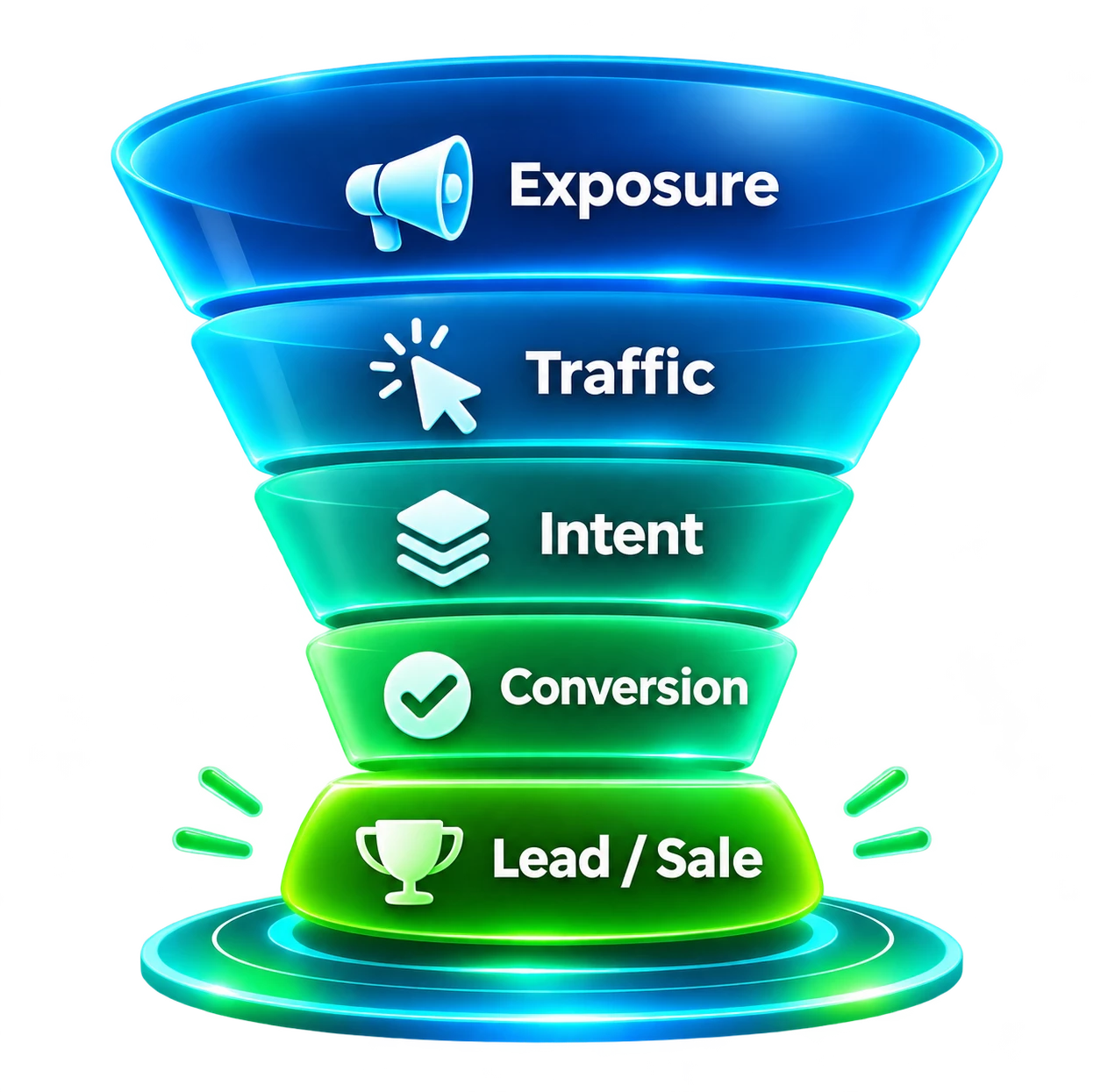
Important Rule: These stages should not be combined into one conversion total. A WhatsApp button click, for example, is an interaction signal. It does not prove that a message was sent or that a sales enquiry was received.
A tracking audit can help investigate missing events, repeated conversions, incorrect triggers, incomplete event parameters, missing purchase values, inconsistent currency information and tags that stop working after a website update. It can also review whether the same action is being sent through more than one tag or platform integration.
When conversion definitions are reliable, marketing teams can make more informed decisions about campaign priorities, audience tests, landing-page changes and follow-up processes. The usefulness of those decisions still depends on traffic volume, lead quality, sales feedback, attribution limitations and the quality of the underlying data.
Effective tracking begins with a measurement plan, not with a tag installation. The plan connects the business objective to an event, a trigger condition, the required event parameters and the platforms that need to receive the information.
The first step is to understand what matters to the business. A lead-generation company may prioritise a successfully submitted enquiry form. An ecommerce store may prioritise a completed and paid purchase. A clinic may want to measure appointment requests, while a B2B company may need to distinguish a demo request from a qualified enquiry.
For each event, the tracking plan should document its name, purpose, trigger condition, required parameters, destination platform and validation method.
| Business Action | Suggested Event | Trigger Condition | Important Distinction |
|---|---|---|---|
| Lead form completed | generate_lead | Confirmed successful form response | Not merely a click on Submit |
| Ecommerce order completed | purchase | Successful order confirmation with transaction data | Not checkout initiation |
| Product added to cart | add_to_cart | Product successfully added | Supporting funnel event |
| Checkout started | begin_checkout | Checkout flow begins | Not a completed order |
| Form interaction starts | form_start | User begins interacting with a form | Not a successful lead |
| WhatsApp CTA selected | custom_interaction | User activates the WhatsApp link | Does not prove a message was sent |
The event names above are examples. The final names and parameters should follow the relevant platform's current event specification and the actual website behaviour.
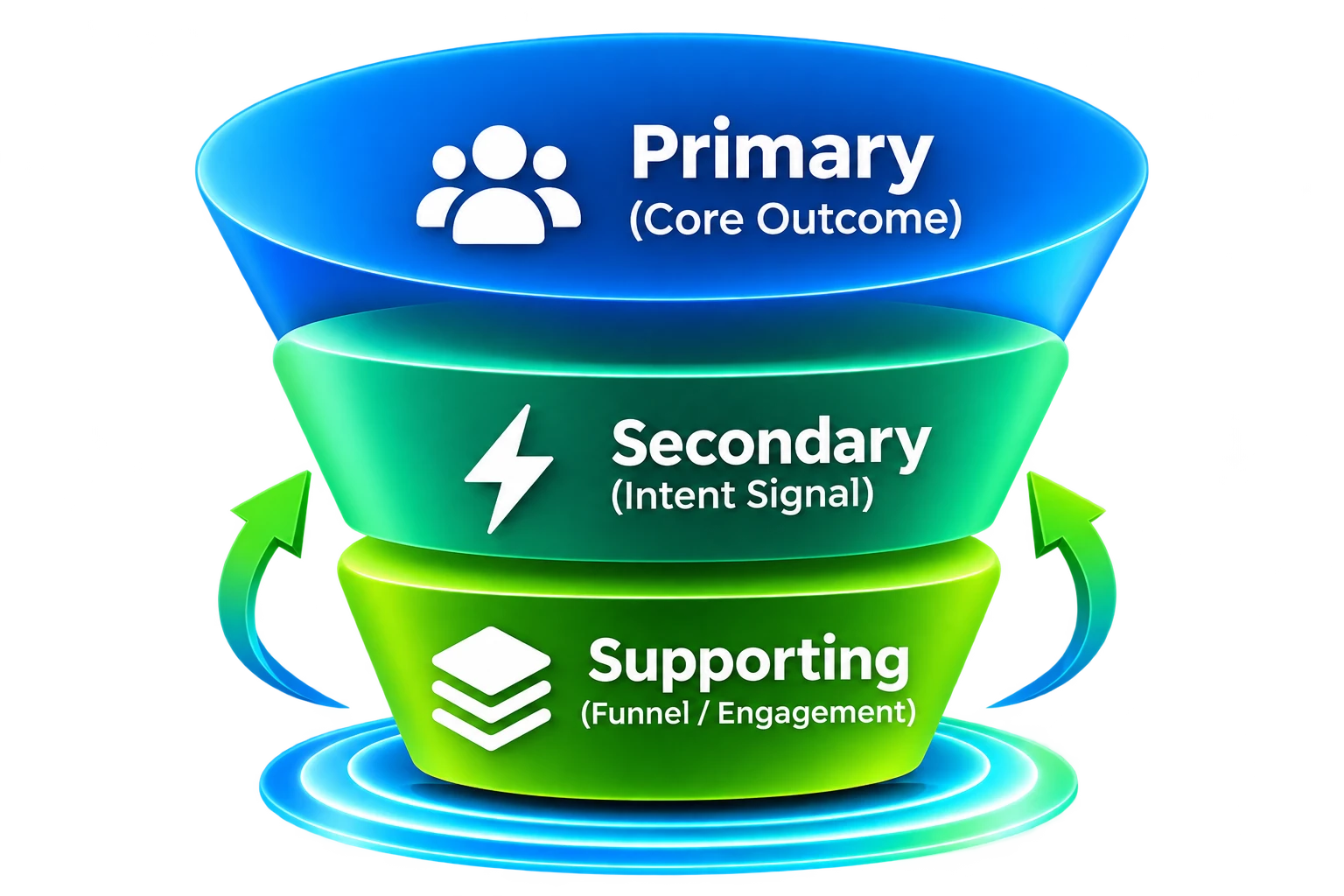
Not every interaction should be used as a primary bidding or business conversion. A primary action should represent the outcome the business wants to optimise towards. Supporting actions can still be recorded for analysis without being treated as equivalent to a sale or qualified lead.
| Event | Typical Measurement Role |
|---|---|
| Successful lead submission | Primary |
| Confirmed ecommerce purchase | Primary |
| Qualified lead imported from a CRM | Primary |
| WhatsApp button click | Secondary |
| Phone-number link click | Secondary |
| Add to cart | Supporting |
| Page view | Supporting |
Events may need additional information to be useful. Depending on the action, the plan can define an event name, trigger condition, value, currency, transaction ID, item information, form type, page context or other relevant parameters. Only data required for the measurement purpose should be collected and sent to each platform. Avoid passing sensitive personal information in URLs, event names or unrestricted custom parameters.
Google Analytics 4 and Google Tag Manager support different parts of a measurement setup. GA4 collects and reports website or app events, while GTM helps deploy and manage tags through configured triggers and variables. Used together appropriately, they can provide a more organised way to manage website analytics and advertising measurement.
Our Google Analytics 4 setup services in Ahmedabad can include reviewing the existing property, configuring or checking the web data stream, confirming the measurement ID, reviewing data collection and defining the events that matter to the business. The configuration should account for the site's actual structure, including forms, ecommerce journeys, booking flows, third-party checkout pages and important confirmation states. Existing GA4 properties should be reviewed before creating a new one, so historical measurement is not unnecessarily fragmented.
Google Tag Manager setup services in Ahmedabad can include creating or reviewing the container, checking the site's GTM installation, organising tags and triggers, configuring variables and implementing event-based measurement. GTM can help manage approved Google and third-party tags without adding every script manually to the website template. For more advanced interactions, a data layer may be required to make confirmed form responses or transaction data available.
GA4 events describe interactions or actions that happen on a website or app. A key event is an event that represents an action important to the business. The implementation should use a suitable recommended event where one exists, such as generate_lead, purchase, add_to_cart or begin_checkout, and use custom events only when the recommended event model does not fit the requirement. Events can be checked through GA4 Realtime reporting and DebugView.
Some website actions cannot be measured reliably through a basic page-load or link-click trigger. Examples include AJAX forms, multi-step forms, custom booking widgets, embedded applications and ecommerce checkouts. In those situations, the implementation may require a custom data-layer event or a developer-supported success signal so the tag fires only after the required action has actually occurred.
Google Ads conversion tracking connects defined business actions with advertising campaign measurement. The setup should identify which conversions matter, how each action is counted and whether the event is suitable for campaign reporting or bidding. FT Nexavvy's Google Ads conversion tracking services focus on implementing and validating the agreed website and eligible call actions.
Depending on the website and campaign objective, website conversion actions can include successful enquiry forms, purchases, registrations, appointment requests, demo submissions and other verified outcomes. The event condition should be based on a successful action, not simply a button click that may fail validation or submission.
The configuration review should consider conversion categories, counting method, conversion value, attribution settings and whether the action should be designated primary or secondary. These settings influence how conversion information is used in reporting and where applicable, automated bidding.
Enhanced conversions can use eligible first-party customer information collected at the point of conversion to supplement measurement, subject to Google's technical requirements, the advertiser's configuration and applicable data-handling obligations.
Call-related measurement involves distinct tiers: tel-link clicks, calls placed through call assets, calls after reaching the site and qualified enquiry calls.
Actual call duration and quality require call-tracking or CRM data and cannot be inferred from a click alone.
Google Ads and GA4 may report different totals because they can use different attribution models, reporting windows, counting methods, event definitions and processing rules. It is not to force every platform to show an identical number, but to confirm that events are defined correctly and reporting differences have a documented explanation.
Meta Pixel and Meta Conversions API support website event measurement through browser and server-side pathways. When both methods send the same conversion action, they must be configured as a coordinated implementation so duplicate reporting is avoided and the event data is checked in Meta Events Manager.
Meta Pixel setup services can include reviewing the existing Pixel, confirming the correct website installation, configuring the agreed browser events and checking whether events are received in the relevant Meta business assets. The implementation should avoid adding another Pixel unnecessarily when a valid installation already exists.
The event plan may include standard events such as PageView, ViewContent, Lead, CompleteRegistration, AddToCart, InitiateCheckout and Purchase, where they accurately describe the user's action. Custom events may be considered for actions that do not fit a standard event.
Meta Conversions API setup can send supported event information from a server or connected platform to Meta. This may complement browser events in an appropriate implementation. The integration depends on the website technology, server or partner connection, access permissions, event source and available data. Server-side implementation is not a reason to send unnecessary or sensitive customer information.
When the same action is sent through both Meta Pixel and Conversions API, the implementation needs a deduplication approach based on the platform's current requirements, including consistent event identification (event_id). Testing should include the relevant event source, event name, identifiers and key parameters in Events Manager.
For businesses running LinkedIn campaigns, the Insight Tag can support website audience and conversion measurement. LinkedIn conversion tracking may use page-based or event-specific actions, depending on the campaign goal and the website journey. This service is included only where the account, website and page content are suitable for the required implementation.
The installation process includes checking whether a tag already exists, obtaining the correct partner or account identifier, adding the tag through an appropriate method and verifying that the site is reporting correctly in LinkedIn Campaign Manager. GTM may be used where appropriate.
Website conversion actions may include demo requests, successful contact forms, B2B enquiries, registrations or other agreed actions. Event-specific tracking is particularly useful when the website does not redirect to a dedicated thank-you page.
Other platforms, such as Microsoft Advertising, may be considered when required by the client's media plan and supported by the implementation team. Platform integrations are not included automatically; the supported platforms, event scope and deliverables are confirmed before work begins.
Website conversion tracking services should reflect the actions that matter to the business, not merely the buttons and links available on a page. This section covers common lead-generation and ecommerce interactions and explains what each event can actually confirm.
Form tracking can cover contact forms, quote requests, appointment requests, demo forms, enquiry forms and other lead-generation journeys. The setup should identify a reliable success signal, such as a confirmed submission response or validated backend event.
Phone tracking may record clicks on tel: links or other call-to-action controls. This is useful for understanding call intent from a page or campaign, but a click does not confirm that a call connected or that the person enquired about the service. Where required, platform call measurement or third-party call tracking may be configured.
Businesses comparing lead tracking services in Ahmedabad often need to measure WhatsApp interactions. WhatsApp click tracking records when a visitor selects a WhatsApp CTA. A WhatsApp click is an intent signal—not proof that a message was sent or received. Later stages require CRM or business process updates.
For booking and registration journeys, events should distinguish between opening a booking form, starting a request, submitting the form and receiving a confirmed booking. This helps the business avoid reporting incomplete requests as confirmed appointments.
Ecommerce conversion tracking services measure events throughout the purchase journey: product views, add-to-cart, checkout initiation and completed purchases. Where supported, purchase events include transaction ID, order value, currency and item details, accounting for reload deduplication.
With CRM or sales-system integrations, downstream milestones can include lead qualification, sales contact, opportunity creation and closed sales. A website form submission should not be described as a qualified lead unless the business has evaluated it against qualification criteria.
Implementation is not complete just because a tag appears in the website source. The tracking must be tested against the intended user journey to confirm that the right event fires, the required parameters are present and duplicate or unintended events are not being recorded.
GTM Preview mode and Tag Assistant inspect which tags fire during a test session, when they fire and what data is available. Testing covers each agreed event before container publication.
The validation process checks whether incoming events reach the intended GA4 property and whether event parameters match the measurement plan via Realtime and DebugView.
Validate conversion actions using Google Ads diagnostic tools and Meta Events Manager test suites. Platform indicators do not replace testing real journeys.
Our diagnostic process reviews common pitfalls that cause reporting inaccuracies:

Common Issue | What Should Be Checked |
|---|---|
Missing conversion event | Trigger conditions, form success signal and tag configuration |
Duplicate conversions | Multiple tags, overlapping plugins or duplicated browser/server events |
Incorrect purchase value | Ecommerce data, currency and transaction parameters |
</>Form conversion not recorded | AJAX response, thank-you state or backend success condition |
WhatsApp click overcounting | Click trigger scope and event definition |
GA4 and Ads reports differ | Attribution, conversion settings, event definitions and reporting windows |
Events stop after a redesign | Updated selectors, URLs, data layer and website structure |
Wrong event parameters | Data-layer values, variable mapping and parameter names |
Where the site and project scope allow, the test plan should include desktop and mobile layouts, key browsers, multi-step forms, embedded widgets, redirect-based journeys, checkout domains and dynamically loaded elements. The objective is to test the actual user path rather than only checking whether a tag can fire on a static page.
Marketing conversion tracking services connect website event measurement with campaign and business reporting. Reporting turns collected events into information that marketing and business teams can interpret. A useful report should state what is being measured, which platforms supplied the data, what the conversion definitions mean and which limitations affect comparison.
GA4 reports events, key events and traffic acquisition, while ad platforms report attributed conversions. UTM parameters label traffic consistently, avoiding naming variations that split reporting groups.
Where agreed, a Looker Studio dashboard consolidates metrics across traffic, events, campaigns, forms and purchases. Note: a dashboard does not fix faulty tags; underlying data must be verified first.
Handover includes an event tracking plan, configured tag list, validation notes, account configuration summary, implementation limitations and reporting recommendations.
A defined implementation process helps keep the project aligned with the client's website, campaign objectives and reporting needs. FT Nexavvy follows a six-stage workflow that can be adapted to the agreed platform and event scope.
Review the existing website, analytics property, GTM container and advertising tags. Identify current events, duplicate implementations, missing measurement and technical dependencies.
Understand the business objectives, define primary and secondary actions, map the user journey and document event names, trigger conditions and required parameters.
Configure the relevant analytics and advertising accounts, measurement settings, tags and integrations based on the approved scope and the client's access permissions.
Implement the agreed form, call, WhatsApp, booking, registration, ecommerce and other website events. Coordinate developer or CRM work when the required success signal or data is not available in the existing site.
Test events through the real user journey, review tag firing and platform receipt, check parameters and duplicate behaviour, and document any unresolved dependencies.
Share the agreed implementation notes, event definitions, validation results and reporting access. Explain any known attribution or data limitations and identify what should be rechecked after major website or checkout changes.
The same tracking tools can support different business models, but the events and definitions should reflect each business's actual customer journey. A generic setup that counts every click as a lead is unlikely to provide useful reporting.
Ecommerce measurement can cover product views, add-to-cart actions, checkout steps, purchase confirmation, transaction ID, order value and currency. The event plan should account for the ecommerce platform, payment flow, refunds where supported and duplicate purchase prevention.
Real estate tracking may include property enquiry submissions, site-visit requests, calls, WhatsApp interactions and later lead qualification. A WhatsApp click or call-button click should remain an intent signal unless a later-stage event confirms an enquiry was received.
Healthcare websites may measure general appointment requests or contact actions where appropriate. Sensitive health information must never be placed in event names, URLs or advertising parameters, and tags must follow strict platform privacy policies.
Education websites track course enquiries, admission forms, demo-class registrations and application submissions. Distinguishing a raw enquiry from an enrolled student requires an integrated CRM or admissions system workflow.
B2B and SaaS tracking may include demo requests, contact forms, free-trial registrations, account creation, qualified leads and subscription events. The measurement plan distinguishes website conversions from later sales pipeline stages.
Local service businesses measure contact forms, click-to-call actions, eligible phone calls, booking requests, confirmed appointments and WhatsApp interactions. These are reported separately so response opportunities are distinguished from completed bookings.
The access required for conversion tracking depends on the website platform, existing implementation and advertising accounts. Before work begins, the project scope should identify who will provide access, which changes require developer support and how account ownership will be maintained.
Implementation may require access to the CMS (WordPress, Shopify, etc.), relevant plugins, form configurations or developer support. Access is strictly limited to the roles needed.
Standard permission requests for GA4, GTM, Google Ads, Meta Business Manager and LinkedIn. Personal passwords should never be shared when platform role delegation is available.
CRM, booking, call-tracking and offline lead management integrations are evaluated based on API feasibility, consent arrangements and data quality.
All accounts and data remain 100% under your business ownership. At handover, you receive full documentation of every tag, container, trigger and property changed.
Conversion tracking can involve information about website visitors and customers. Implementation should therefore consider the website's consent mechanism, applicable data-protection obligations, platform policies and the principle of collecting only what is needed for the agreed measurement purpose. This section is general implementation information, not legal advice.
Where a CMP is used, tracking passes consent choices to compatible tags. Google Consent Mode communicates consent signals to Google tags; it does not replace the banner used to obtain consent.
Features using first-party info must identify necessary fields, ensure secure collection, and verify that the intended use is supported by lawful notices and consent.
Avoid sending sensitive personal info through event names, URL parameters or pixels. Healthcare and financial journeys require strict policy checks before deployment.
The plan must align with platform terms and Indian data-protection requirements (DPDP). Hashing a field or enabling Consent Mode does not independently establish legal compliance.
A suitable conversion tracking agency in Ahmedabad should be able to explain how it defines events, implements tags, validates the result and documents the limitations. When comparing a conversion tracking company in Ahmedabad, look beyond a list of tools and ask how the provider will measure the actual actions that matter to your business. A conversion tracking consultant in Ahmedabad should also be able to explain which outcomes can be measured directly and which require CRM call-tracking or sales data.
Before hiring an agency, verify how they handle testing, event taxonomy, and account governance.
Ask whether the team has experience with the website platform, forms, checkout flow and advertising accounts used by your business. Relevant examples should explain the implementation problem and how it was validated, without exposing another client's confidential data.
A provider should explain the difference between a click, a submitted form, a qualified lead and a confirmed sale. Ask how primary and secondary conversions will be defined and how the setup will avoid treating every interaction as a lead.
Ask which tools and checks will be used to validate GA4 events, GTM tags and advertising-platform conversions. The provider should be able to explain how it checks missing events, duplicate events, event parameters and website changes.
Confirm whether the project includes an event plan, implementation notes, screenshots, a dashboard, ongoing monitoring or only a one-time setup. The deliverables should be written into the scope so expectations are clear.
Check who owns the analytics and advertising accounts, how access is granted and how the client receives the final configuration and documentation. Avoid arrangements that leave the business unable to access its own measurement assets.
Conversion tracking pricing depends on the website, the number of platforms, the number and complexity of events and the level of testing and integration required. A straightforward tag review is different from a multi-platform implementation involving ecommerce data, a custom data layer, server-side events or CRM-based offline conversion tracking.
The main factors include:
FT Nexavvy can assess the website and platform requirements before confirming the appropriate scope. Any quoted price should reflect the actual implementation work rather than an arbitrary fixed package.
Find answers to common questions about GA4, GTM, Meta Pixel, call tracking, offline conversions and implementation requirements.
Conversion tracking services involve planning, configuring and validating measurement for important website and marketing actions, such as successful form submissions, eligible calls, registrations and ecommerce purchases. The setup may use tools such as GA4, GTM, Google Ads conversion tracking, Meta Pixel and other supported integrations to connect defined actions with reporting platforms.
Conversion tracking helps your business distinguish traffic and clicks from measurable enquiries, registrations and purchases. It can show which actions are being recorded and how available campaign data relates to those actions, helping teams make better-informed marketing decisions.
Google Analytics 4 is an analytics platform that receives and reports events from a website or app. Google Tag Manager is a tag-management system that helps deploy and control tags through triggers and variables. GTM can send events to GA4 and advertising platforms, but it is not a replacement for GA4 reporting.
Yes, Google Ads conversion tracking can be configured for agreed website actions such as successful lead forms, purchases or registrations, subject to the website and account setup. Eligible call measurement and enhanced conversions can also be reviewed where the required platform, technical and data conditions are met.
A website can generally record WhatsApp-button clicks and phone-number link clicks as interaction events. Those clicks do not prove that a WhatsApp message was sent or that a call connected. Actual calls, qualified enquiries and confirmed bookings require suitable platform call measurement, a call-tracking solution or a CRM/business process where available.
Meta Pixel sends supported website events from the visitor's browser, while Conversions API can send supported events from a server or connected system. They can complement each other, but when both send the same action the implementation must follow Meta's event-deduplication requirements to avoid duplicate reporting.
Conversion tracking can be implemented on WordPress, Shopify and other platforms, but the method depends on the site's theme, plugins, forms, checkout configuration and available integrations. Some projects require developer support or a custom data-layer event, especially for AJAX forms and non-standard checkout flows.
Stop evaluating marketing performance through clicks and website traffic alone. Build a measurement setup that distinguishes meaningful website actions, successful enquiries and completed purchases—and makes clear what each platform is reporting.
FT Nexavvy can review your existing tracking, define the events that matter to your business and scope the required implementation across supported analytics and advertising platforms. Whether you need a new setup, an audit of missing or duplicate events, or clearer reporting for leads and sales, the first step is to understand your website and measurement requirements.
Share your website URL, the platforms you use and the tracking issue you want to solve. The required access, event scope and deliverables can then be confirmed before implementation begins.

DIGITAL MARKETING AGENCY IN AHMEDABAD

Working Hours
Monday – Saturday 9:00 am – 6:00 pm ( Sunday > Closed )
Services
Use Cases
Travel
Health & Fitness
Educations
News App
Food Order & Delivery App
Work inquiries
Interested in working with us?
hello@ftnexavvy.com
Call : +91 90303 48383
Ahmedabad Office:
A-531, Money Plant High Street,
Gota, Ahmedabad - 382470
Looking for a job opportunity?
See open positions
Sign up for the newsletter










Disclaimer
© 2025-2026 Nexavvy. All rights reserved.