FT Nexavvy LogoCONTACT US
Digital Marketing for Ahmedabad Startups

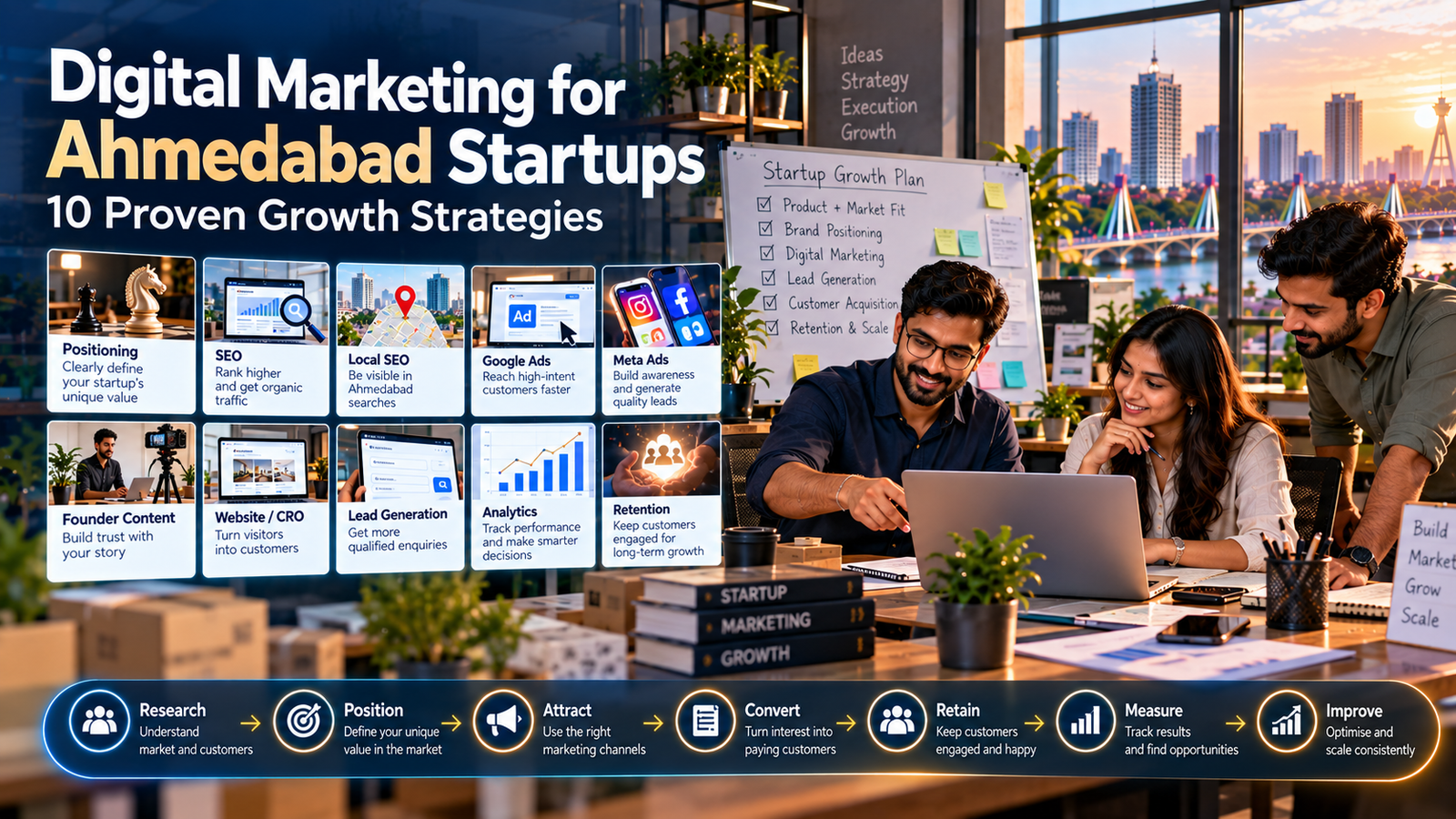
Digital Marketing for Ahmedabad Startups: 10 Proven Growth Strategies

Digital MarketingOctober 2, 202625 MIN Read    BYFT Nexavvy
Digital Marketing for Ahmedabad Startups: 10 Proven Growth Strategies Starting a business is hard. Getting the right customers is often harder.
For Ahmedabad startups, digital marketing can help turn a new business into a visible and credible brand. But simply creating an Instagram account or running Google Ads is not a complete strategy.
A startup needs a clear digital marketing strategy that connects brand discovery, customer acquisition and revenue.
That means understanding the Ahmedabad market, defining the right audience, building online visibility, choosing the right marketing channels and measuring what actually produces customers.
The good news is that startups do not need to use every digital channel from day one.
They need the right channels in the right order.
This guide explains 10 practical digital marketing strategies that Ahmedabad startups can use to build visibility, generate qualified leads and create a scalable customer acquisition system.

What Is the Best Digital Marketing Strategy for Ahmedabad Startups?

The best digital marketing strategy for an Ahmedabad startup starts with a clear target audience, strong positioning and measurable business goals.
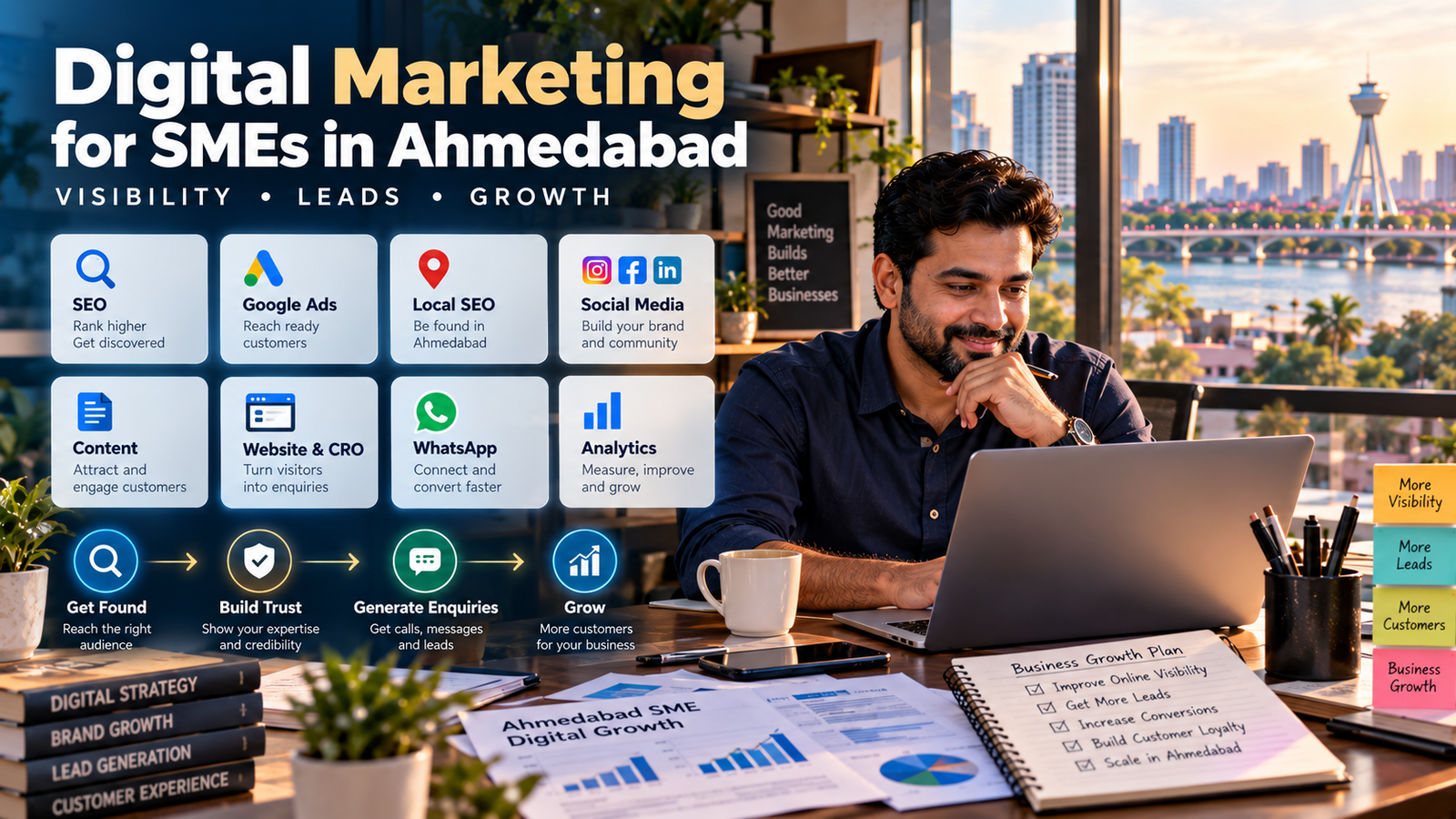
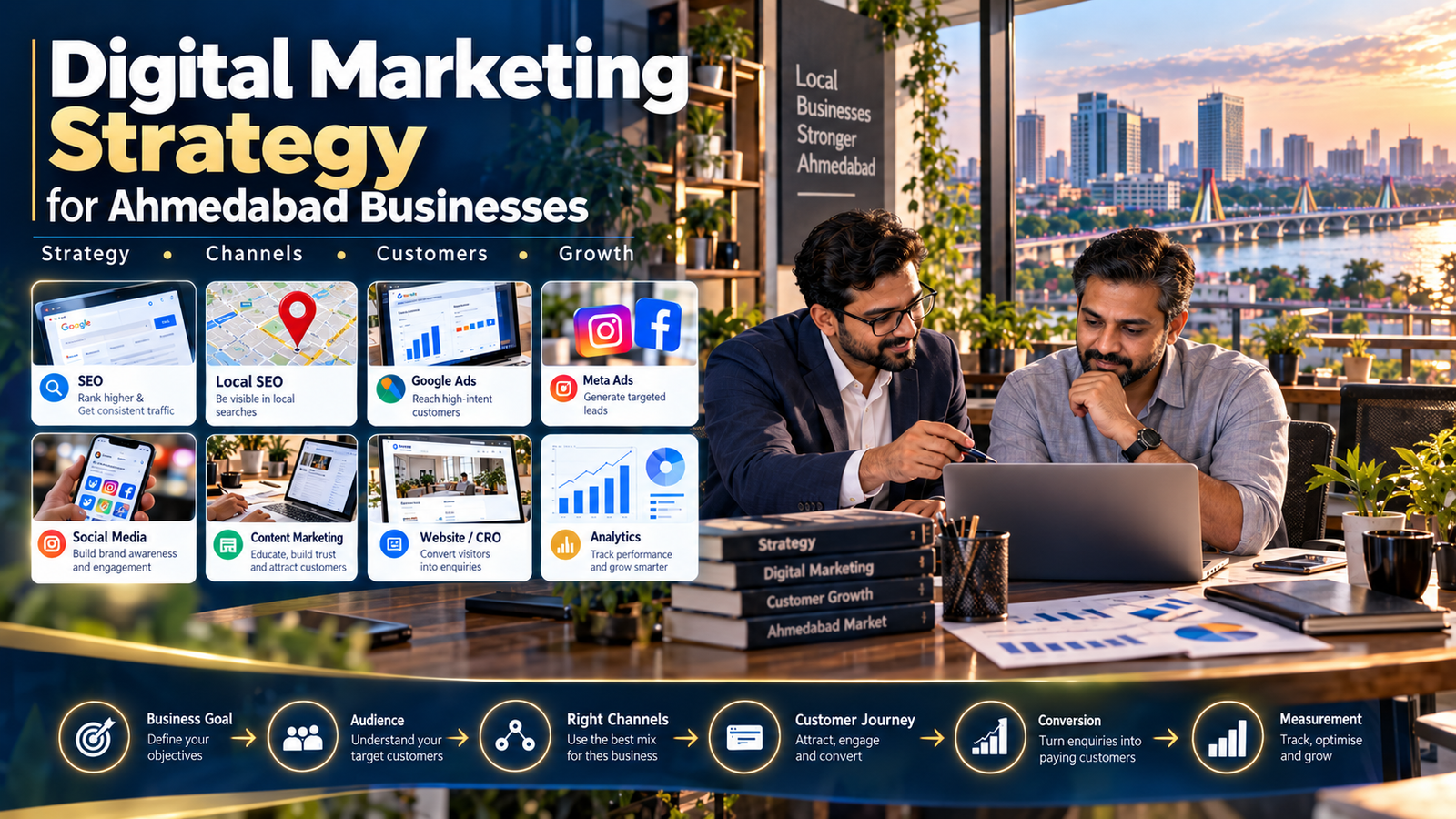
Build your online presence around SEO, Local SEO where relevant, Google Ads, Meta Ads, content marketing, social media and a conversion-focused website.
Start with one or two channels that match your customer's buying behaviour instead of spreading the budget everywhere.
Use content and SEO to build long-term organic visibility, paid advertising to capture demand faster, and analytics to understand which campaigns produce qualified customers.
As the startup grows, add CRM, remarketing, marketing automation and conversion optimisation to create a more scalable customer acquisition system.

"For an Ahmedabad startup, digital marketing is not about trying every channel at once. It is about building a connected customer acquisition system that scales."

– FT Nexavvy
Why Digital Marketing Matters for Ahmedabad Startups

A startup can have a strong product and still struggle to grow if potential customers cannot find it.
Digital marketing helps solve that visibility problem.
For an Ahmedabad startup, the opportunity can come from several sources:
  • Google Search
  • Google Maps
  • Instagram
  • Facebook
  • LinkedIn
  • YouTube
  • Online communities
  • Content marketing
  • Paid advertising
  • Referrals and reviews
But visibility alone does not create a successful startup.
The real objective is to move people through a journey: Awareness → Interest → Trust → Enquiry → Purchase → Retention
This is why startup marketing should connect branding, customer acquisition and conversion.

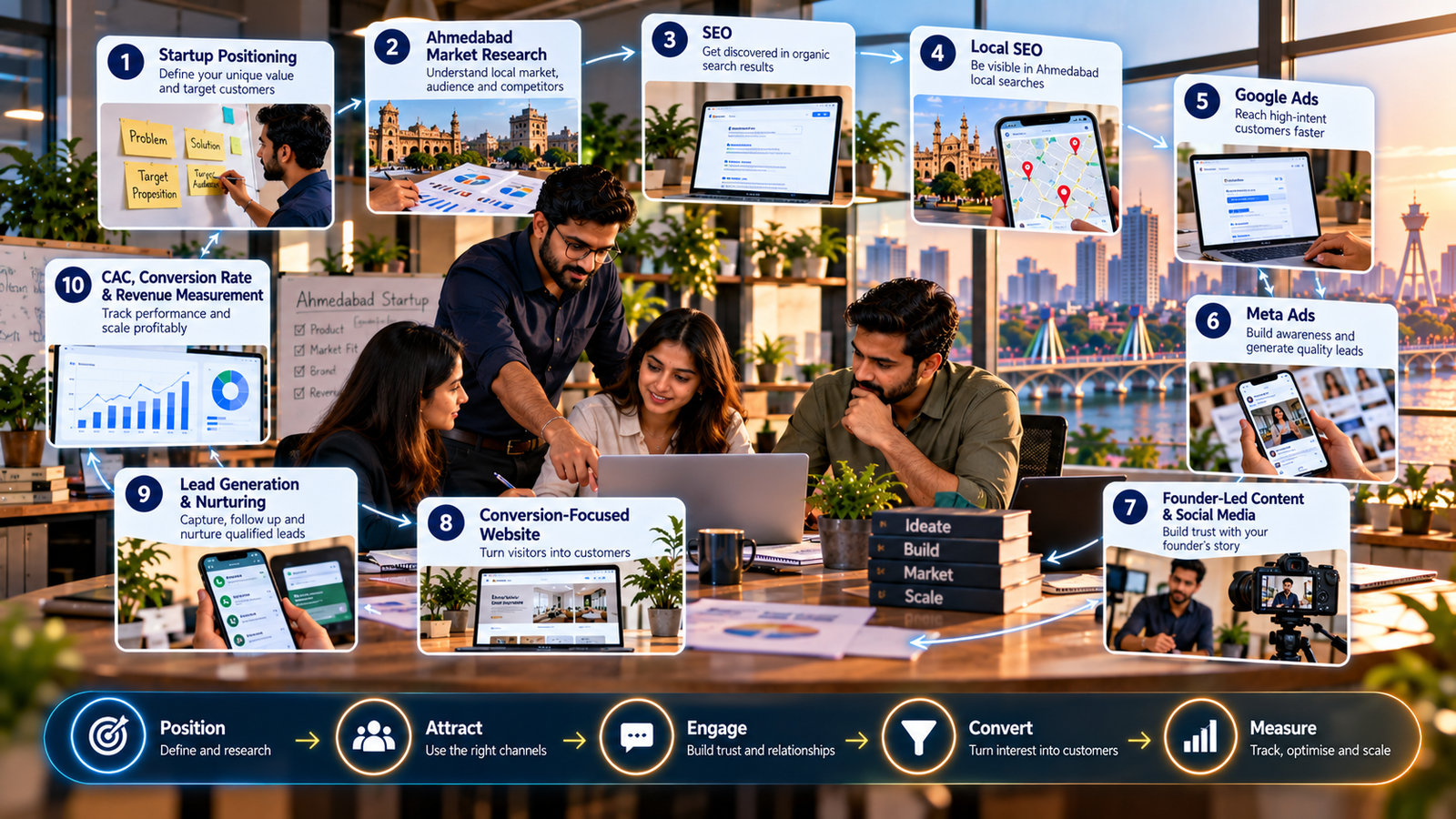
10 Digital Marketing Strategies for Ahmedabad Startups

Digital Marketing for Ahmedabad Startups: 10 Proven Growth Strategies

1. Define Your Startup Positioning Before Marketing

Before spending money on advertising, make sure people understand what your startup actually does.
Your positioning should answer:
  • Who do you help?
  • What problem do you solve?
  • Why should customers choose you?
  • What makes your solution different?
This becomes your value proposition.
Example: Suppose an Ahmedabad startup develops software for small manufacturers. A weak message might be: “Innovative technology solutions for modern businesses.” It sounds professional but says very little. A stronger message could be: “Production management software designed for small and mid-sized manufacturers.” Now the audience understands the product.
Build your positioning around four elements: target customer, customer problem, product or service, and clear benefit. Your website, ads, social media and content should repeat the same core positioning. Consistency helps build brand recognition and trust.

2. Understand the Ahmedabad Startup Market

Ahmedabad has a broad business ecosystem. It includes traditional businesses, manufacturing companies, family-run enterprises, professional services, ecommerce brands, technology businesses and emerging startups. That creates opportunities for startups, but it also creates competition.
Before launching campaigns, study your local market. Research: existing competitors, customer needs, local search behaviour, pricing expectations, competitor positioning, review patterns, customer complaints, popular services, and local demand.
A simple market research process:
  1. Search your main service on Google.
  2. Study the companies appearing in organic results and Google Maps.
  3. Read customer reviews.
  4. Look for repeated complaints and unmet needs.
  5. Study competitor offers.
  6. Build your positioning around a real customer problem.
This creates an advantage that generic marketing cannot provide.

3. Build an SEO Strategy for Long-Term Growth

SEO can become one of the most valuable acquisition channels for a startup. For startups building sustainable organic visibility, a focused SEO strategy can help attract relevant prospects throughout the customer journey.
Unlike paid advertising, organic visibility can continue generating traffic after the initial content investment. But startup SEO should focus on relevance and intent, not just search volume.
Start with keyword research: Find searches related to your product, service, customer problems, comparisons, alternatives, pricing, locations, and industry questions. Then classify keywords by intent:
  • Informational intent: What is CRM software?, How does inventory management work?
  • Commercial intent: Best CRM for small businesses, CRM software for manufacturers
  • Transactional intent: Buy CRM software, CRM demo, CRM pricing
Your content strategy should address each stage.
Build topical authority: Instead of publishing random blogs, create content clusters. For example: Pillar: CRM Software for Small Businesses. Supporting articles: CRM benefits, CRM implementation guide, CRM vs spreadsheets, CRM pricing, CRM features, CRM mistakes, CRM comparison. Link these articles naturally. This creates a stronger topical structure and helps users move from research to conversion.

4. Use Local SEO When Your Startup Serves Ahmedabad Customers

Not every startup needs Local SEO. If your startup serves customers in Ahmedabad through a physical location or local service area, it can be extremely useful. For startups competing in location-based searches, local search optimization can improve visibility across Google Search and Maps while helping nearby customers discover the business.
Important assets include Google Business Profile, Google Maps, local landing pages, customer reviews, local keywords, consistent business information, and location-specific content.
Local search example: A healthcare startup might target searches such as “healthcare services in Ahmedabad”. A food startup might depend on searches around specific neighbourhoods. A local professional service could benefit from “service provider near me”.
Avoid location stuffing: Do not write: Best startup company Ahmedabad Ahmedabad Gujarat. That creates poor content. Instead, explain genuine local relevance: where you serve, which Ahmedabad areas you cover, what local customers need, how your service works locally, and why your offer suits the regional market. Local SEO should improve discovery, not simply add city names to pages.

5. Use Google Ads to Capture High-Intent Customers

Startups often need customers before SEO has built significant organic traffic. Google Search Ads can help capture people who are already looking for a solution. A well-structured Google Search Ads campaign can put your startup in front of high-intent users while giving you measurable data about clicks, leads and acquisition costs.
For example: “accounting software for small business” shows stronger commercial intent than “how does accounting software work?”.
Build campaigns around intent (high-intent keywords, product searches, service searches, brand searches, competitor searches, location-based searches). Match the landing page—if the ad promotes a specific product, send users to that product page (do not send every visitor to the homepage). Track: click-through rate, cost per click, conversion rate, cost per lead, qualified leads, and customer acquisition cost. The goal is not cheap traffic; the goal is profitable customer acquisition.

6. Use Meta Ads to Build Demand and Awareness

Google captures people who are already searching. Meta Ads can help you reach potential customers before they actively search. For startups, this can be valuable for brand awareness, product discovery, lead generation, retargeting, product launches, and community building. Platforms include Facebook and Instagram.
Example: Imagine an Ahmedabad D2C startup launching a new consumer product. A potential customer may discover the product through Instagram. They watch a short video. Later, they see a testimonial. Then they receive a retargeting advertisement. The customer journey becomes: Discovery → Engagement → Trust → Retargeting → Purchase. This is why social advertising should be viewed as part of the customer journey rather than a standalone campaign.

7. Build a Founder-Led Content and Social Media Strategy

For early-stage startups, founders can be powerful marketing assets. People often want to understand why the company exists, what problem inspired it, how the product works, what the founder has learned, what customers are saying, and what the company believes.
This is where founder-led content can work well. Create founder stories, product lessons, customer stories, industry insights, behind-the-scenes content, short educational videos, product demonstrations, case studies, and startup journey updates.
Platform selection: LinkedIn for B2B, founders, SaaS and professional services; Instagram for consumer brands, visual products and community-driven businesses; YouTube for education, product demonstrations and deeper storytelling; Facebook for local communities and broader B2C audiences. Do not copy the same post everywhere without adapting it to the platform.

8. Build a Conversion-Focused Website

Your website is one of the most important digital assets your startup owns. A strong website conversion strategy makes it easier for visitors to understand your offer, trust your startup and take the next step. Traffic is useful only when visitors understand what you offer and know what to do next.
Your homepage should communicate: what you offer, who you help, main benefit, proof, and CTA.
Important conversion elements: clear headline, strong value proposition, product or service explanation, testimonials, case studies, customer logos, FAQs, pricing information where appropriate, contact options, and demo or consultation CTA.
Keep the customer journey simple: Problem → Solution → Benefits → Proof → CTA. This can significantly improve user experience.

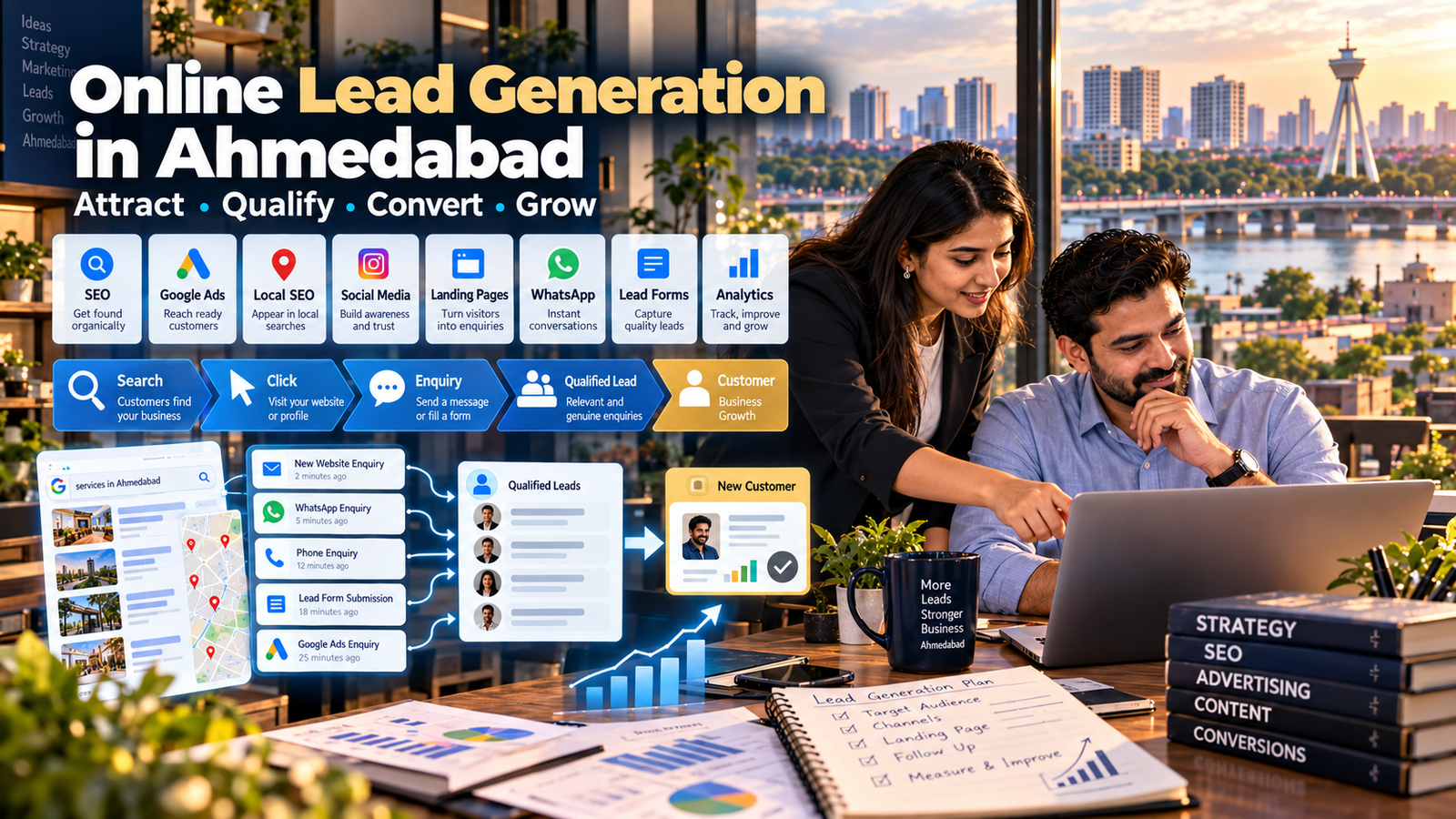
9. Build a Lead Generation and Nurturing System

A startup may generate traffic and still struggle to grow because its lead management process is weak. Lead generation should not stop at the form submission.
The complete process is: Traffic → Lead Capture → Qualification → Nurturing → Sales → Customer.
Lead capture options depend on your business: contact forms, demo requests, free consultations, WhatsApp, phone calls, newsletter signup, product trials, and downloadable resources. Qualify leads by checking customer need, budget, timeline, location, business fit, and buying authority. This helps sales teams spend more time with qualified prospects.
Lead nurturing: not every prospect buys immediately. Use email sequences, educational content, case studies, product updates, retargeting, and follow-up calls. The objective is to stay useful until the customer is ready.

10. Measure CAC, Conversion Rate and Revenue

A startup cannot scale what it cannot measure. Marketing analytics should show which activities create customers.
Important metrics:
MetricWhat It Tells You
Website trafficReach and visibility
Lead volumeNumber of enquiries
Lead qualityRelevance of prospects
Conversion rateEfficiency
Cost per leadAcquisition efficiency
CACCost to acquire a customer
CLVCustomer value
ROASPaid advertising efficiency
RevenueBusiness impact
RetentionLong-term growth
CAC vs CLV: One of the most important startup metrics is the relationship between Customer Acquisition Cost (CAC) and Customer Lifetime Value (CLV). If acquiring customers costs ₹5,000 and the average customer generates only ₹3,000 in total value, scaling the campaign creates a bigger problem. If customer value significantly exceeds acquisition cost, the startup has more room to scale. Do not judge a campaign only by its lead volume. Judge it by the quality and economic value of the customers it creates.

Which Digital Marketing Channel Should an Ahmedabad Startup Use?

There is no single best channel for every startup. The correct choice depends on the product, audience, buying cycle and available budget.
ChannelBest UseMain AdvantageLimitation
SEOLong-term acquisitionCompounding organic visibilityTakes time
Google AdsHigh-intent demandFaster trafficRequires ongoing budget
Meta AdsAwareness & demandStrong audience targetingIntent can vary
LinkedInB2BProfessional targetingCan be expensive
ContentEducation & trustBuilds authorityNeeds consistency
Local SEOLocal customersLocal discoveryLimited for non-local models
EmailNurturingDirect communicationNeeds an audience
RemarketingRe-engagementRecovers interested usersNeeds existing traffic

Startup recommendation

If resources are limited, avoid launching everything simultaneously. Choose channels based on the customer's buying journey.

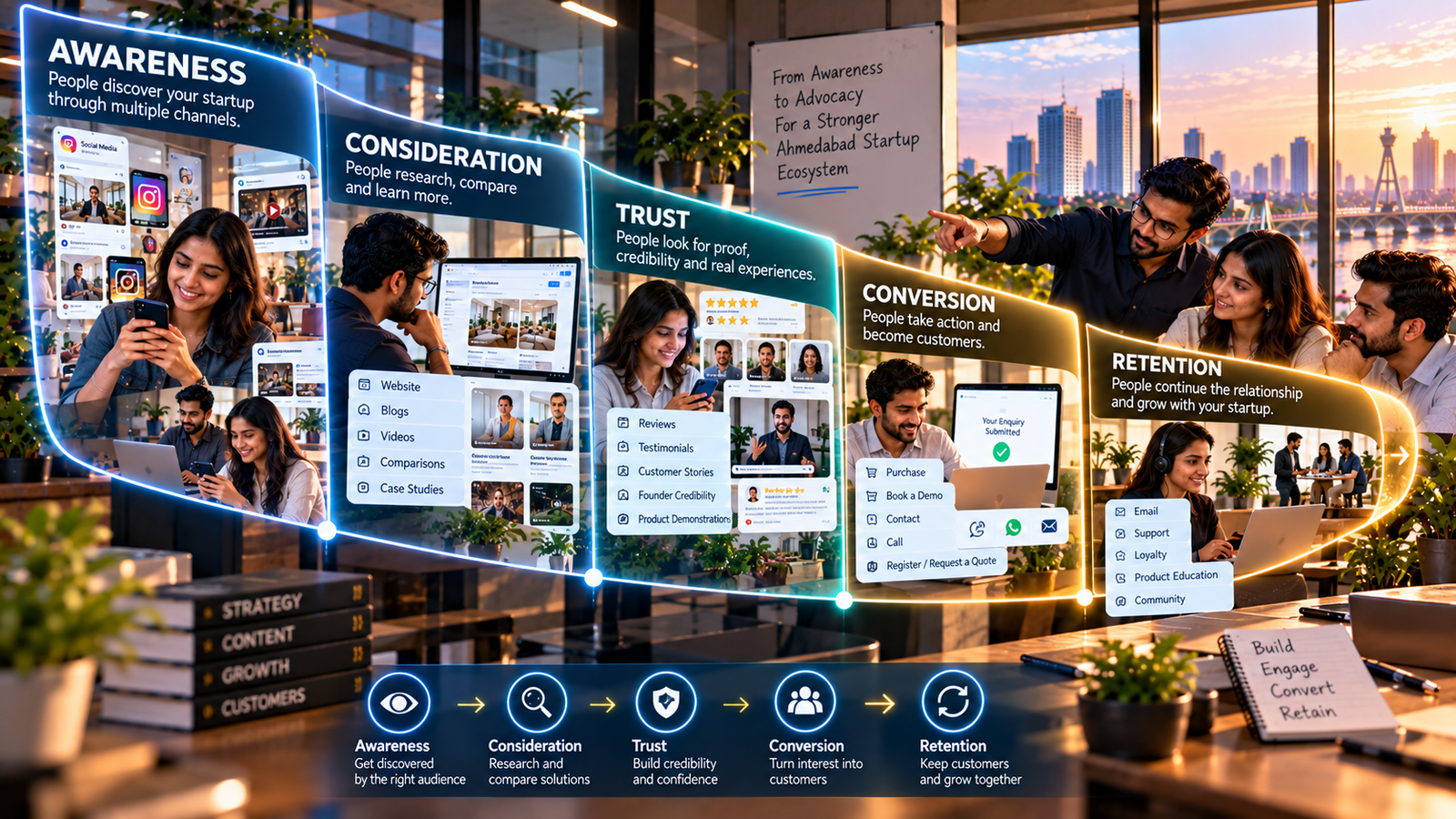
A Practical Startup Digital Marketing Funnel

A Practical Startup Digital Marketing Funnel
A startup can use this simple funnel:

Stage 1 — Awareness

Customers discover the brand.
Channels: Social media, SEO, YouTube, Paid social, PR

Stage 2 — Consideration

Customer investigates the solution.
Assets: Website, Blogs, Videos, Comparisons, Case studies

Stage 3 — Trust

Customer wants evidence.
Use: Reviews, Testimonials, Customer stories, Founder credibility, Product demonstrations

Stage 4 — Conversion

Customer takes action.
Examples: Buy, Book demo, Contact, Call, Register, Request quote

Stage 5 — Retention

The customer continues the relationship.
Use: Email, Support, Loyalty, Product education, Community

This turns digital marketing into a complete growth system.

How Much Should an Ahmedabad Startup Spend on Digital Marketing?

There is no universal number. A startup should first understand its unit economics.
Consider: average order value, gross margin, customer lifetime value, sales conversion rate, CAC, available cash, and growth target.
Instead of asking: “How much should I spend?”, ask: “How much can I sustainably spend to acquire one profitable customer?”. That is a much better decision-making framework.
Start small and learn: A practical approach is: Test → Measure → Improve → Scale. Do not increase advertising spend simply because impressions and clicks are increasing. Scale after you understand lead quality and customer economics.

Common Digital Marketing Mistakes Ahmedabad Startups Should Avoid

1. Trying Every Channel

More channels create more complexity. Start with the channels that match your audience.

2. Running Ads Without Tracking

Without conversion tracking, you cannot judge performance accurately.

3. Focusing Only on Followers

Followers are not customers.

4. Ignoring SEO Until Later

SEO can take time, so delaying it for years can create a costly visibility gap.

5. Publishing Random Content

Content should support customer questions and business goals.

6. Weak Positioning

If customers cannot understand your value quickly, acquisition becomes harder.

7. Sending Traffic to a Poor Website

Advertising cannot compensate for a confusing website.

8. Ignoring Lead Follow-Up

Good leads can become lost opportunities if response time is poor.

9. Measuring Only Cost Per Lead

Cheap leads are not necessarily valuable leads.

10. Scaling Before Finding Product-Market Fit

Marketing can amplify demand. It cannot permanently fix a product customers do not want.
Expert Framework: The Startup Digital Growth Loop

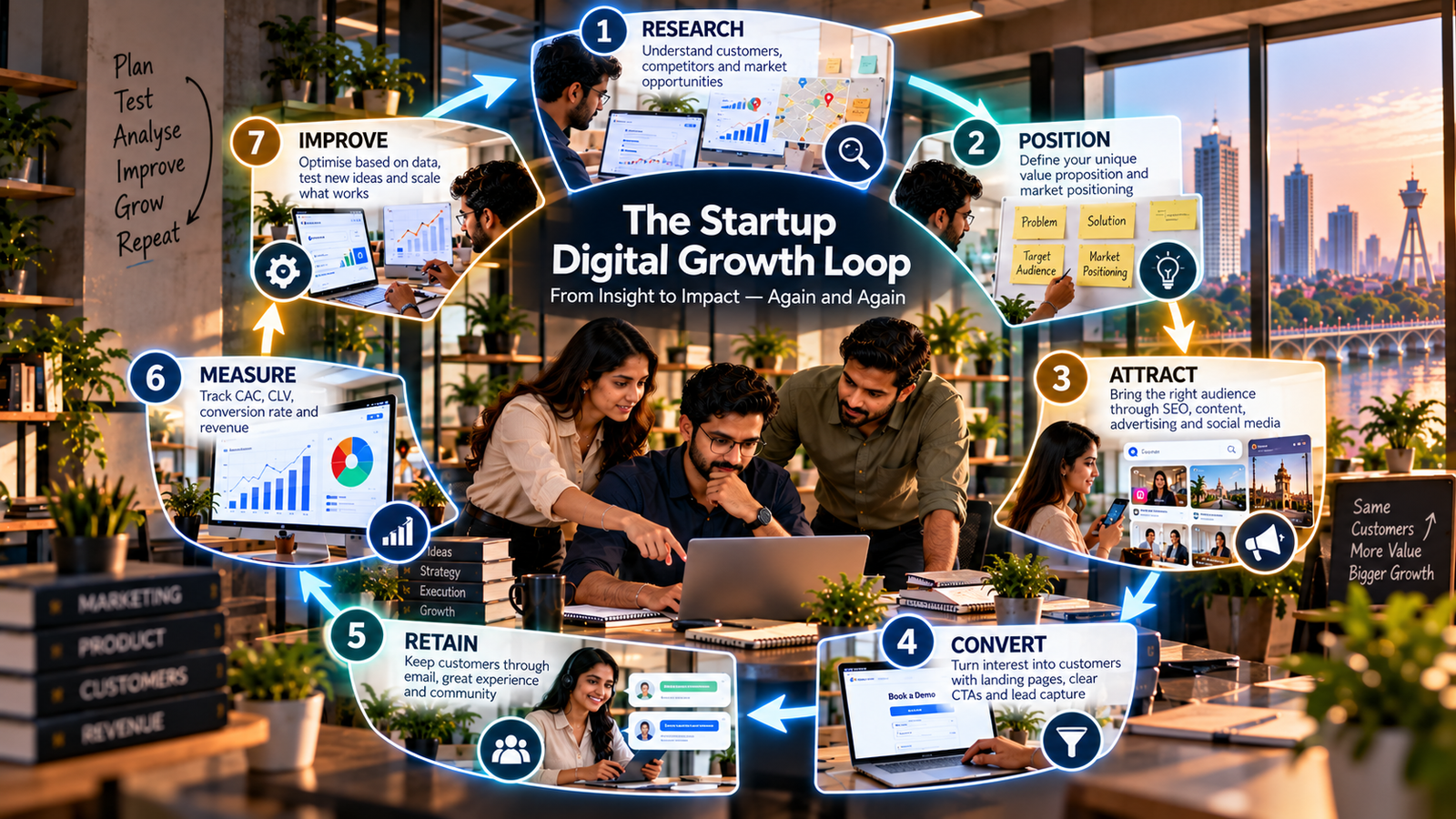
Expert Framework: The Startup Digital Growth Loop
A useful way to think about startup marketing is as a loop:
Research → Position → Attract → Convert → Retain → Measure → Improve
  • Research: Understand customers and competitors.
  • Position: Create a clear value proposition.
  • Attract: Use SEO, content, ads and social media.
  • Convert: Use landing pages, CTAs and lead capture.
  • Retain: Use email, customer experience and community.
  • Measure: Track CAC, CLV, conversion and revenue.
  • Improve: Use data to strengthen the weakest stage.
This creates a repeatable growth process.

Ahmedabad Startup Examples

Example 1: B2B SaaS Startup

A SaaS startup selling software to Ahmedabad SMEs could use: SEO + LinkedIn + Google Ads + Founder Content + Demo Landing Page + CRM. Its main goal should be qualified demos rather than website traffic.

Example 2: D2C Startup

A consumer brand could use: Instagram + Meta Ads + Influencer Content + SEO + Remarketing + Ecommerce CRO. Its primary metrics could include conversion rate, CAC, average order value, and repeat purchase rate.

Example 3: Local Healthcare Startup

A healthcare startup serving Ahmedabad could use: Local SEO + Google Business Profile + Google Ads + Educational Content + Reviews. Its key conversion might be an appointment rather than an online purchase.

Example 4: Real Estate Startup

A property-focused startup could combine: SEO + Property Pages + Google Ads + Meta Ads + WhatsApp + CRM. Lead qualification could include budget, preferred area, property type, and purchase timeline.

AI Marketing for Ahmedabad Startups

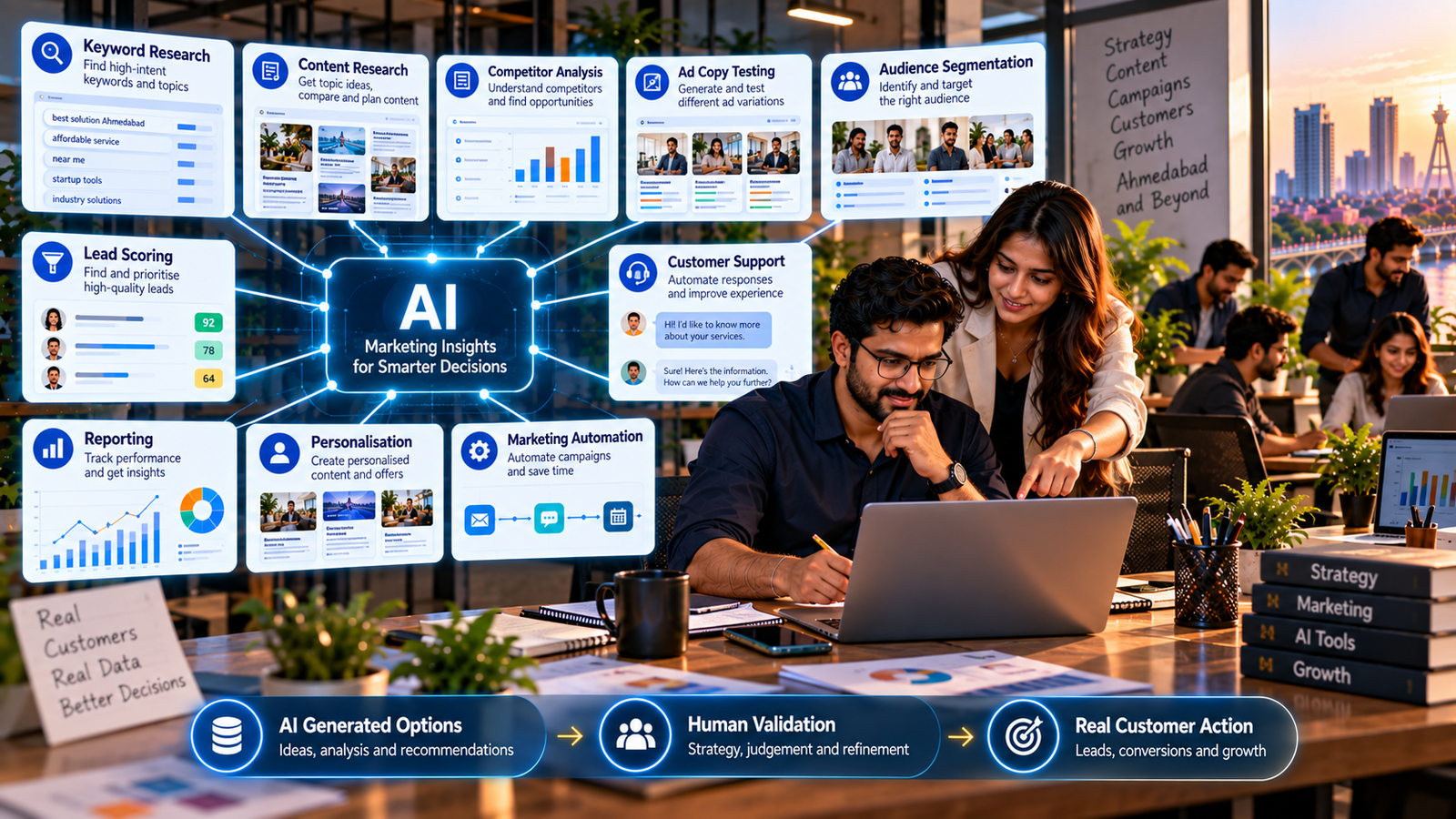
AI Marketing for Ahmedabad Startups
AI can reduce the time required for several marketing tasks. Startups can use AI to support keyword research, content research, competitor analysis, ad copy testing, audience segmentation, lead scoring, customer support, reporting, personalisation, and marketing automation.
But AI should not become a replacement for customer insight.
For example, AI can generate ten ad variations. A marketer still needs to determine: Which message is credible? Which audience is valuable? Which offer fits the product? Which campaign creates profitable customers?
The best approach is: AI tools + human judgement + real customer data

90-Day Digital Marketing Plan for an Ahmedabad Startup

90-Day Digital Marketing Plan for an Ahmedabad Startup

Days 1–30: Foundation

Week 1: Define target audience, customer problem, value proposition, business goals, and marketing KPIs.
Week 2: Research competitors, keywords, search intent, customer questions, and local demand.
Week 3: Build website messaging, landing pages, conversion tracking, and Google Business Profile if relevant.
Week 4: Launch the first acquisition channels. Start with one or two priorities rather than everything.

Days 31–60: Acquisition

Focus on: SEO content, Google Ads, Meta Ads, social content, and lead generation. Measure: traffic, leads, qualified leads, conversion rate, and cost per lead.

Days 61–90: Optimisation

Now identify best-performing keywords, best audiences, best landing pages, best content, and best campaigns. Then improve the weakest parts of the funnel. Scale only after identifying what produces profitable customers.

Frequently Asked Questions

Digital marketing for startups is the use of online channels such as SEO, paid advertising, social media, content and websites to build awareness, acquire customers and support business growth.

It helps startups build online visibility, reach targeted customers, compete with established businesses and measure customer acquisition more effectively.

There is no universal answer. SEO, Google Ads, Meta Ads, content and social media can all work depending on the audience and business model.

Yes, especially if potential customers search online for the startup's product, service or problem. SEO can build long-term organic visibility.

Yes. Google Ads can help capture customers who already have strong search intent, provided campaigns are properly targeted and tracked.

Meta Ads can be useful for awareness, demand generation, lead generation and remarketing, particularly for B2C businesses.

No. Local SEO is most useful when customers search for local businesses or the startup serves a specific geographic market.

They can use SEO, Google Ads, Meta Ads, landing pages, content marketing, social media, lead forms, WhatsApp and other conversion channels.

Startup SEO is an SEO approach designed around a startup's target audience, business model, search demand and growth stage.

Customer acquisition cost is the average amount spent to acquire one new customer.

Customer lifetime value estimates the total value a customer generates throughout the relationship with the business.

It helps startups understand how much they can reasonably invest in customer acquisition and whether growth is economically sustainable.

SEO timelines vary based on competition, website authority, technical condition, content quality and search demand. It should generally be treated as a long-term investment.

There is no fixed amount. Budget should depend on customer value, margins, acquisition economics, growth targets and available resources.

Track qualified leads, conversion rate, CAC, CLV, ROAS, revenue, retention and channel performance.

Conclusion

Digital marketing can give Ahmedabad startups a powerful way to compete with larger and more established businesses.
But the objective should not be to simply create more content, run more ads or collect more followers.
The objective is to build a repeatable customer acquisition system.
Start with positioning. Understand the Ahmedabad market. Identify how your customers search and make decisions. Choose the channels that match that journey. Build useful content and strong conversion assets. Then measure what happens after the click.
The most effective startup growth loop is: Research → Position → Attract → Convert → Retain → Measure → Improve
For an early-stage startup, this approach creates something more valuable than temporary visibility. It creates a foundation for scalable, measurable and sustainable growth.

Ready to Build a Digital Growth Strategy for Your Startup?

If your Ahmedabad startup is struggling with online visibility, qualified leads, customer acquisition or inconsistent marketing performance, start by auditing the complete customer journey.
Review your: SEO, Local SEO, Google Ads, Meta Ads, Website, Content strategy, Lead generation, CRM, Conversion tracking, and Customer acquisition economics.
The right strategy should not be built around doing everything. It should be built around finding the few marketing activities that consistently move your startup toward profitable growth.
For a broader view of how SEO, paid advertising, content, social media, website development and analytics can work together, explore our Digital Marketing Agency in Ahmedabad service approach.

Author

FT Nexavvy

FT Nexavvy

FT Nexavvy editorial team.

InstagramFacebookTwitterLinkedIn

ON THIS PAGE

Have a Project?
Let’s talk!

green tick

NDA? Absolutely just ask.

green tick

We’ll respond in 24 hours fast & focused.

green tick

Work with senior UX experts, not juniors.

Schedule a call:

Mr Panchal

Founder & CEO

How can we help you?

Send Message

Prefer email?

hello@ftnexavvy.com

UI/UX DESIGN
WEBSITE DESIGN
BRANDING
GOOGLE ADS
SEO
SOCIAL MEDIA MARKETING
UI/UX DESIGN
WEBSITE DESIGN
BRANDING
GOOGLE ADS
SEO
SOCIAL MEDIA MARKETING
UI/UX DESIGN
WEBSITE DESIGN
BRANDING
GOOGLE ADS
SEO
SOCIAL MEDIA MARKETING
FT Nexavvy Logo

DIGITAL MARKETING AGENCY IN AHMEDABAD

ISO Certification Badge

Working Hours

Monday – Saturday 9:00 am – 6:00 pm ( Sunday > Closed )

Use Cases

Travel

Health & Fitness

Educations

News App

Food Order & Delivery App

Work inquiries

Interested in working with us?
hello@ftnexavvy.com

Call : +91 90303 48383

Ahmedabad Office:
A-531, Money Plant High Street,
Gota, Ahmedabad - 382470

Career

Looking for a job opportunity?
See open positions

Sign up for the newsletter

flag-1flag-2flag-3flag-4flag-5flag-6flag-7flag-8flag-9flag-10

Disclaimer

FT NEXAVVY PRIVATE LIMITED (CIN:U62011GJ2025PTC168186) is a registered company under the Companies Act, 2013.
We operate with GST (GSTIN:24AAGCF6405M1ZJ), PAN ( AAGCF6405M), TAN (BRDF01128B), DPIIT Registration (DIPP225956), and MSME / UDYAM Registration (Udyam No:UDYAM-GJ-01-0555205).

Our brand name FT NEXAVVY is currently under Trademark Application (Application No:7297017) with the relevant authorities in India.

We are committed to providing transparent, ethical, and result-driven digital solutions. While our strategies are based on proven industry standards, actual results may vary depending on market conditions, competition, and platform algorithm updates.

As a responsible agency, we do not guarantee fixed sales, instant leads, or overnight rankings. Digital success requires consistent effort, collaboration, and long-term commitment. All services are executed only as per the mutually agreed scope of work in our service agreements.Any additional tasks or requirements may involve revised terms.

For your safety, please note that FT Nexxavy Private Limited has not authorized any third party or individual to make commitments, promise guaranteed results, or operate accounts on your behalf. Always communicate with us only through our official channels for authentic updates and support.

If you find any unauthorized use of our brand name, please report it immediately at legal@ftnexavvy.com

© 2025-2026 Nexavvy. All rights reserved.

Nexavvy